Do you want to know how long to make a story?

Size matters.

Some say write until your done, but as with all things, there is a rule of thumb. And knowing where the goal-line is may be helpful.

Want to know the answer?

I do agree we should write until finished, however, goals and guidelines are helpful. And as usual, successful writers/bloggers come to the rescue. With the help of friends, you can take the guesswork out of the numbers. 
 

Flash Fiction?

Generally, unless restricted by rules of a publication or contest, the word count for Flash Fiction is under 1,000. If submitting to a specific publication be sure and check their requirements.

A Drabble?

A Drabble is exactly 100 words, not including the title. Writing 100 words is not as easy as you might think. Takes practice. Give it a try.

Short story?

A short story length generally falls somewhere between 1,500 and 4,000 words. As with flash fiction, if submitting to a specific publication, check their rules.

Novelette, Novela?

In our fast-paced world, the Novelette and Novela are becoming very popular.  A Novelette is usually between 7,000 and 20,000. The Novela word count is between 20,000 -40,000.

Novel or Epic?

Novels vary between 40,000 – 110,000 depending on genre. Writing an epic is a big challenge. These tombs are over 110,000. Whew!

Here are my own cheat sheets.
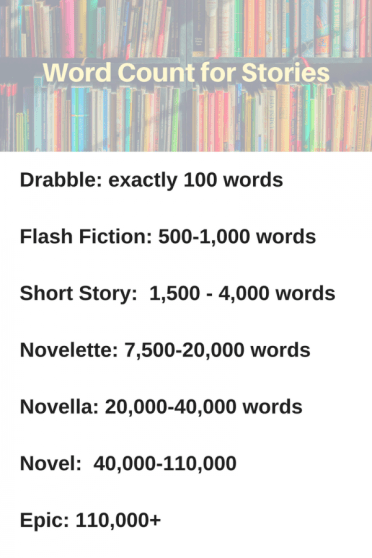
Feel free to copy and paste them into your computer.

Robin Woods breaks down the word count further into genres. Be sure and read her post…

WORD COUNT 101: NOVEL? NOVELLA? NOVELETTE?


Christine Frazier breaks down the books into chapters and chapter count. This information can be really helpful in keeping your book consistent. Know where and how to break a chapter is important. Unless there is a compelling reason, you wouldn’t want your book to give the reader whiplash with one chapter 1000 words and the next one 4,500. Christine breaks down a few popular novels for us.

Playing the Numbers: Basic Word Counts by 


As with all rules, some are made to be broken. But, I find having guidelines and goals make me a better writer. What about you?

Want to read more about correct word counts keep reading. Here are more great posts on the subject.

Novel and Short Story Word Counts | WritersDigest.com 

What is the Perfect Length of Short Stories? 

How to Write a Drabble

Was this information helpful?

Do you think guidelines are useful?

Leave me a comment and tell me what you think.

I HOPE YOU’LL TAKE A MINUTE TO FOLLOW ME ON SOCIAL MEDIA, JUST CLICK ON THE BUTTONS BELOW. I’LL LEAVE A LIGHT ON.


Do you think Bestseller lists have lost value?

Do you know what it means to be a bestselling author?

Well, for one thing, it may no longer mean a lot of books were sold. Think about that for a minute.

These questions, plus a few more, bounced around in my mind after reading a blog post on the Texas Authors website. (If you live in Texas be sure and check out this great organization.) Now back to the blog post that caught my attention.

Does Anybody Know What a Bestseller Is? By John Maher, with reporting by Rachel Deahl and Claire Kirch | Nov 03, 2017

The post pointed out something I’m sure most of us have noticed or read about, an overabundance of categories and subcategories on Amazon. You name it and the giant e-tailer most probably has a subcategory for the subject. Under Art & Photography, I counted 17 subcategories, one named Vehicle Pictorials. 

Before the gold rush of ebooks, there were two main categories for bestselling books—fiction and non-fiction. These two categories were broken down further into three major print formats—hardcover, trade paperback, and mass market paperback. The simplicity of this system made for easy tracking of bestselling books.

But then came ebooks, a new fourth category, and sold online. Online sales aren’t monitored or cataloged by brick-n-mortar stores, therefore, sales are not tracked in the same manner as print books.


While Amazon reports print sales, provided by Nielsen BookScan, it does not, for the most part, disclose sales of e-books. This sales number also does not include, sales to libraries, purchases by wholesalers such as Ingram, sales of used books, fulfillment by Amazon (FBA) sales or pre-orders—orders for a book before the book is released.


So who provides the most reliable guide for a bestseller list?

From John Maher’s article, I learned…

  • The two most transparent and reliable tracking organizations are:
    • NPD BookScan’s  and PW (Publishers Weekly) point-of-sale data, tracks 80%–85% of print sales in the country, but there again doesn’t (or can’t) track ebooks. Which, although good, provides an incomplete overall view.
  • Due to the number of lists, and Amazon’s decision not to share its e-book sales figures, it’s next to impossible identify what the top-selling books are across all formats in a particular week.
  • Which Bestseller lists carry weight with bookstores and readers?
  • I know it would stoke my ego, but having a book dubbed a “Bestseller” may not always translate into sales. Not like in the past. But what does translate into sales are:
    • Good reviews, coverage in high-profile media, and word-of-mouth.

Okay! I’ve got a few questions for you…

Do you think the term “Bestseller” or Bestselling Author” has become watered down by Amazon?

Do you believe it helps book sales? Print or ebook?

Did you know Amazon doesn’t report ebook sales?

Have you been disappointed after buying a book listed as a “Bestselling Novel?” (I have.)

Want to read more on the subject? Click on these posts!

Behind the Scam: What Does It Take to Be a ‘Best-Selling Author’? $3 and 5 Minutes.  By 

How Many Books Do You Need To Sell To Become A Bestseller?

I HOPE YOU’LL TAKE A MINUTE TO FOLLOW ME ON SOCIAL MEDIA, JUST CLICK ON THE BUTTONS BELOW. I’LL LEAVE A LIGHT ON.


What do you think are the most popular genres?

Is your genre one of the top percenters?

I hadn’t given this much thought, until reading a great article on Medium by Erica Verrillo from the Writing Cooperative. And boy howdy, the stats were eye-opening. Erica gives stats on most popular genres with readers, agents and includes which genres make the most money.

What surprised me most?

Most books sold by genre…

  • #1Children’s Fiction sells more than three times the number of adult books.

    #1 in sales – Children’s fiction
  • #2Adult General Fiction came is second in sales.

Agents most requested genre…

  • First Choice of Agents is NOT Children’s books, although these books are number one in sales.#1 – Request by agents is YA Fiction.

    YA Fiction #1 requested
  • #10Last on the lists for Agent request is Women’s Fiction. I’d expected this to be higher.
  • Agents work on commission of 15%.

The genre that makes the most money…

Romance #1 money-maker
  • #2Crime and Mystery novels
  • #3 – Inspirational and Religious books, (go figure.) This includes self-help books.
  • #4 – Fantasy and Science Fiction
 Click and read Erica’s article to discover all the nitty-gritty details.

What are the most popular literary genres? By Erica Verrillo

Where did your genre fall?
Any surprises?
Will any of these stats change your approach to writing?


INQUIRING MINDS WANT TO KNOW. Talk to me IN THE COMMENTS.

And take a minute to follow me on social media, just click on the buttons below. I’ll leave a light on.


Writing and need help? Check out this terrific list

Thanks to   over at Publishing… and Other Forms of Insanity, for providing us with such an extensive list of websites.

There is something here for every writer. There is information on queries, marketing, publishing as well as how to write a good book. So get ready because if you’re like me,  down the rabbit hole, you’ll go, once you begin to click. 

Which of the 27 websites is new to me?

  1. Agent Query.  Although I’m nowhere ready to send out queries, this will definitely go on my “hope to need” list.
  2. Free Writing Events. Yay! Who doesn’t want to submit without the added cost of submission fees? Oh yeah, this one is a definite must-read.
  3. The Grinder. Like Erica, I once used Durotrope until they became a paid service.  I can’t wait to check out this one.
  4. Jae Writer. Now this one sounds like the perfect website to learn more about the craft of writing. Count me as a new follower.
  5. Manuscript Wish List (#MSWL). Whoa! What writer wouldn’t want to get inside the mind of agents and editors?
  6. The Passive Voice. Again, a great blog to learn what agents think. Plus, a bit of legalese from an attorney.
  7. Pub Crawl. Here you can find an insider’s perspective from authors and publishing professionals. Cool!
  8. Savvy Writers. Almost a million followers!  Doris-Maria Heilmann blogs cover everything you ever wanted to know about publishing your book.
  9. Susan Dennard. Her blog is filled with writing and publishing resources for aspiring authors. Everything from story-telling to the finished book.
  10. Women Writers, Women’s Books. All things about women authors. Well, I definitely qualify.
  11. Writing Career. Provides places that actually pay writers. Alright!

Not bad! I’m familiar with 16 of the 27! Now I can’t wait to dive into the other 11  websites. I just love learning new stuff! Gonna be a busy weekend of reading. See you on the other side of that rabbit hole. LOL

Want to know more!

Click and read about all of the great links on Erica’s website. 

27 Great Websites for Writers  by 

Did you discover a new website?
Are any of the 27 a favorite?
Do you use any of these websites? Which ones?

Leave me a comment. I can’t wait to read your thoughts or suggestions.

And take a minute to follow me on social media, just click on the buttons below. I’ll leave a light on.