Are you timid about promoting your book?

Do you fear sounding like a Twitter or Facebook Harpie?

Buy mine! Buy Mine! Buy Mine!
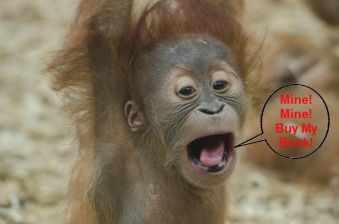
buy_mine

Well, I do.

I want to sell my little book as much as any other author, but I don’t want to beg. There has to be a better way than flooding social media with ads.

Thanks to Chris over at THE STORY READING APE for another terrific find. I don’t know where he manages to find so many amazing and informative websites, but I’m so glad he does.

I devoured this one on how to market a book without posting ads by the thousands on Twitter, Facebook or Instagram.

As an introvert, some of these would be difficult for me, but one of my goals for 2016 is to move a little more out of my comfort zone. The first step toward that goal, is participating in a local Author Con in the Spring.

You may not want to use all of her tips, but even one or two of these ideas could be the springboard you’ve been searching for to launch your book.

Are you ready to move beyond social media to promote your book?

Could you do a book fair, meet with a book club or do an interview with the local media?

Or how about my favorite on her list, create a holiday

Click below and read the entire article. Let me know which of her ideas you think have merit.

How to promote a book without using social media by Author Sandra Beckwith

What did you do to market your book? Did it work? 

Talk to us. Inquiring minds want to know.

You can find me on Twitter @jeancogdell, Facebook at jean.cogdell and Amazon.com, stop by and say hey! Please remember to with a click and share this post with your Twitter peeps and Facebook fans.


Should you open with dialog or not, that is the question

If you must, keep it short and sweet.

Has it been done? Of course! Does that mean we should try it? That’s a loaded question.

The first line is how we, the writers, introduce our story to the reader. It’s how we shake hands, say hello, howdy, nice to meet you or whatever greeting we choose to grab the reader’s attention.

hand-861275_640

The first line can’t be wasted words.

When a story is opened with dialog, will the reader know who is speaking? If not, the author must backtrack, and pretty quick, to show who is talking and why. This can become confusing fast.

head-927180_640

I’m not sure that I’m that talented of a writer.

If using dialog to open a story, it must reveal the character, and support, highlight or assist action. The dialog can be captivating, and attention grabbing, but it cannot be just for the sake of conversation. Just like any opening line, it must hook the reader and propel the story.

The reader is then thrown into a whirlwind of turbulence trying to figure out whose on first, doing what. You risk losing them before you can ground them in the story.

There are right and wrong ways to use dialogue to start your story. Merideth Storms give several tips on how to make sure the dialog serves to reveal the plot and move the story forward. Click and read her post: 

Using Dialogue to Start a Short Story, a Creative Writing Technique by Merideth Storms

Everyone has heard not to start a story with a dream, staring into a mirror and yes opening with dialog. But now we know all “rules” are not steadfast when bent or broken by writers who know how to use them. There is another “no-no rule” I’d not heard about. 

Too little dialog in the opening paragraphs. This can signal to an editor the story is might be boring, filled with more telling than action. Read more from Courtney Carpenter: 

5 Wrong Ways to Start A Story By:

More tomorrow on a stories first words

You can find me on Twitter @jeancogdell, Facebook at jean.cogdell and Amazon.com, stop by and say hey! Please remember to with a click and share this post with your Twitter peeps and Facebook fans.

How to make your own editing rules sheet

Professionally known as a Style Sheet.

I’m not referring to a list of what matches what hanging in your closet.

Or the hottest trends from InStyle Magazine. 

No, this is a document where you define the writing style and rules that apply to your WIP.

  • Is the style of your WIP American or British English? 
  • Do you use contractions? (This is one of my problems. Sometimes I feel like a contraction sometime I don’t.)
  • Are you going to spell out the numbers or not?

See where I’m going? Finding these errors first is very important to presenting quality work to an editor that you’ve done some of your own redline editing.

I call mine a cheat sheet. Some writers use an electronic file folder, others like Scrivener’s templates to help with character info to keep the story uniform. 

But, now that I understand the importance of an actual Style Sheet is, I’m going to streamline the process for my next project. 

Why do I want to use a Style Sheet like Sue Archer shares in her blog? Because my “cheat sheet” has grown into a large folder. And as such, too big to be of much use.

This one sheet, when applied to each individual project will make polishing my stories much easier. You might want to click on Sue Archer’s blog and check out the template she provided. I did. 

Robin Rivera gives 3 Reasons Authors Need Style Sheets 

Take special note of #2. Amazon will soon be holding writers to a higher standard and consistency in our books will be more important than ever. 

Hopefully, using this process will produce a more professional piece and prevent an editor from cringing at first glance. 

What about y’all? 

Do you use a Style Sheet for consistency? For editing?

If not, what do you use? 

Talk to me people. My inquiring mind wants to know.

You can find me on Twitter @jeancogdell, Facebook at jean.cogdell and Amazon.com, stop by and say hey! Please remember to with a click and share this post with your Twitter peeps and Facebook fans.

Sometimes the easiest is the most direct

Like, use what is right in front of me. There’s not a long learning curve with a program I already know. Duh!

This appears to be a lesson I seem destined to learn the hard way over and over.

After spending all day, and I do mean all day, researching and downloading various programs I figured out what I’d been using was the best all along. Go back to the tried and true. 

All that time wasted. Sometimes I’m so hard-headed. 

Me- Duh Jean M Cogdell

However, one good thing did come out of it. 

I came across a valuable post filled with information. Information that I did need. 

Do you know how many pages a children’s picture book should have? 

Do you know how it should be constructed? Exactly? Dough boy - building crane JeansWriting.com

Picture Book Dummy, Picture Book Construction: Know Your Layout by Tara Lazar

You see, my editor had just suggested I make up a dummy of my new children’s book before going in further. She thought a dummy might help me get a handle on the correct size of the book and the illustrations.

So I guess my day wasn’t wasted after all. 

Thanks, Ms. Lazar for this timely bit of info. With your post maybe I’ll avoid a lot of mistakes.

Now this dummy is off to lay out a dummy of

“A Most Reluctant Princess.”

Throne Screen Shot 2016-01-16 at 9.22.25 PM - Copy

I hope some of y’all find the information as helpful as I did. If you did, talk to me…

You can find me on Twitter @jeancogdell, Facebook at jean.cogdell and Amazon.com, stop by and say hey! Please remember to with a click and share this post with your Twitter peeps and Facebook fans.