Hunting for symbols?

I use Scrivener and MS Word for my writing.

Don’t ask why, I’m just weird that way. However, Sometimes my writing flow is interrupted when I can’t remember the shortcut key for a specific symbol.

Searching through the Insert Symbol tab is like coming to a stop sign.msword
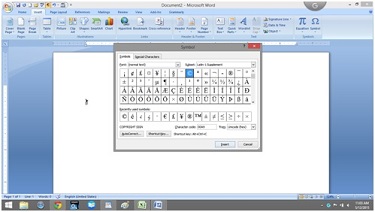
To ease my irritation a little, I made a cheat sheet and thought I’d share.

So if you are tired of searching for just the right symbol as if you’re looking for a matching pair of socks in a drawer that won’t close. Hope this helps.

Shortcut keys for symbols

Ctrl+Alt em dash
Ctrl+W Close the active window / document.
Ctrl+Z Undo an action.
Ctrl+Y Redo the last action or repeat an action.
Ctrl+S Save a document.
Ctrl+P Print a document.
Ctrl+K Insert a hyperlink.
Alt+Left Arrow Go back one page.
Alt+Right Arrow Go forward one page.
Ctrl+C Copy selected text or graphics to the Office Clipboard.
Ctrl+V Paste the most recent addition to the Office Clipboard.
Ctrl+Shift+A Format all letters as capitals.
Ctrl+B Applies or removes bold formatting.
Ctrl+I Applies or removes italic formatting.
Ctrl+= Apply subscript formatting (automatic spacing).
Alt, F, A Save As.
Alt, S, T, I Insert Table of Contents.
Alt, S, T, R Remove Table of Contents.
Alt, W, F Full Screen Reading – View > Document Views > Full Screen Reading.
Alt, W, R Ruler. View > Show/Hide > Ruler.
Alt, F, X  Exit Word.

For less commonly used keyboard combinations check out this website:

http://www.internet4classrooms.com/msword_keyboard_ibm.htm

For more Alt symbol codes go to:

http://www.alt-codes.net/

I love comments, tell me what’s happening with you and if you’re not already, please follow @jeancogdell on Twitter!

Anatomy of a Best-Selling Story—Part Two

Yea, here’s the second installment from Kristen Lamb. The timing couldn’t have been better for me. I’ve been working on my story structure the last few weeks. Trying anyway. So thanks Kristen.

Author Kristen Lamb's avatarKristen Lamb's Blog

Image via Flickr Creative Commons, courtesy of Mike Licht Image via Flickr Creative Commons, courtesy of Mike Licht

Last post, I started talking about the dreaded topic…structure. I write these posts because I really DO want you guys to succeed and as an editor for far too many years, the single biggest reason most new novels flop? Structure. Pretty prose does not a novel make. Each of these blogs will build upon the previous lesson. By the end of this series, I hope you to give you guys all the tools you need to be “structure experts.”

Yes, even the pantsers.

Structure is one of those topics that I feel gets overlooked far too much. There are a lot of workshops designed to teach new writers how to finish a novel in four weeks or three or two or whatever. And that is great…if a writer possesses a solid understanding of structure. If not? At the end of…

View original post 1,724 more words

Writing with Expression

Want to give life to your writing?

In an earlier post I discussed Tropes and their technical writing terms. After reading Kristen Lamb’s post on story structure I became fascinated with their use and a link she provided to tvtropes.org.

Full Definition of TROPE

  1. a word or expression used in a figurative sense: figure of speech
  2. a common or overused theme or device: cliché
  3. The use of a word or expression in a different sense from that which properly belongs to it; the use of a word or expression as changed from the original signification to another, for the sake of giving life or emphasis to an idea; a figure of speech.

Tvtropes.org explains – a trope can be a plot trick, a setup, a narrative structure, a character type, a linguistic idiom… you know it when you see it. Tropes are not inherently disruptive to a story; however, when the trope itself becomes intrusive, distracting the viewer rather than serving as shorthand, it has become a cliché.

Who knew tropes could be so helpful with scenes?

Need help with a story arc? A scene situation?

Find some puzzle pieces to help you flesh out the picture.

Your only limited by your imagination.

This is a fascinating, fun website that provides tips and help with story arcs in every genre a writer can think of. Careful, don’t get lost.

Who knew there were so many types of love scenes? 

Thanks Kristen for the link. I hope you’ll have as much fun as I did exploring how to give life to your writing.

I love comments, tell me what’s happening with you and if you’re not already, please follow @jeancogdell on Twitter!

Anatomy of a Best-Selling Story—Structure Part One

Prose is not a novel. Kristen Lamb explains why we can write lovely vignettes but fall short completing a 80-100,000 word novel. Can’t wait for the next helpful post.

Author Kristen Lamb's avatarKristen Lamb's Blog

Structure Matters Structure Matters

Writers must understand structure if they hope to be successful. Yes, it might take five years to finish the first novel, but if we land a three book deal, we don’t have 15 years to turn in our books. Also, in the new paradigm of publishing, writers who produce more content have greater odds of making money at this writing thing.

Understanding structure helps us become faster, cleaner, better writers. Structure is essential to all stories, from screenplays to novels to epic space operas.

Plotters tend to do better with structure, but even pantsers (those writers who write by the seat of their pants) NEED to understand structure or revisions will be HELL. Structure is one of those boring topics like finance or taxes. It isn’t nearly as glamorous as creating characters or reading about ways to unleash our creative energy.

Screen Shot 2015-01-20 at 11.15.49 AM

I’ve run my 20 page Death Star Critique…

View original post 1,659 more words