Do you need help with structure?

I do! And I’m still learning how to outline a story with a structure that doesn’t collapse at the first strong wind of criticism.

building-block-606439_640

Have you ever loved a story, but wondered why no one else did?

sad-674811_640

Me too.

Often.

I’m a pantster. Nothing better than sitting down and letting my muse loose on the keyboard. Too bad, writing by stream of consciousness often ends, as do most streams, into a raging uncontrollable river. And where do rivers end? Into a vast ocean, that’s where.

Then after spending hours, days and sometimes months writing thousands of words, all I can do is try not to drown amid the ocean of a rambling story. So I give up and decide to fix it another day. I’ve no idea how this happened.

Does any of this sound familiar?

I’ve begun to fear; my problem may be lack of structure.

If you’re a pantster, don’t go to yelling just yet. I’m still a pantster but, I’m learning to use structure. Because I believe there’s a way to marry both the outline structure and write pantster style.

Got a story that just aggravated you almost to insanity? Nothing is working? Take it and try breaking it down into 3 simple acts and then break those acts down further.

Got an idea for a story? Start by simplifying it with 3 acts. Then one idea under each act and an idea under each one of those headings.

Here is the basic outline I’m working with.

Act I – Opening

  1.  Hook – conflict
  2. Protagonist in daily life before transformation
  3. Opportunity to change
  4. Resistance to change
  5. Point of no return
  6. Opportunity accepted

Act II – Entering the new situation

  1. Location
  2. Meeting friends, enemies, romance;
  3. Transformative experiences
  4. Problem brings them together
  5. Problem drives them apart
  6. Crisis Hits

Act III

  1. Terrible Secret Revealed

By breaking down the story little by little, I’m giving it time to grow and hoping to find more freedom and inspiration with smaller chunks.

One of my favorite books is Save the Cat Kindle Edition by Blake Snyder and although the book is primarily focused on script writing the principles can be applied to writing a story.

So tell me, do you use the 3 Act structure or a more indepth outline? 

Do you write with or without an outline?

You can find me on Twitter @jeancogdell, Facebook at jean.cogdell and Amazon.com, stop by and say hey! Please remember to with a click and share this post with your Twitter peeps and Facebook fans.


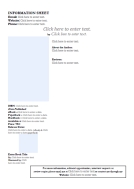
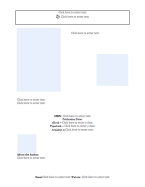
Here are the Free, Info Templates I promised

Not one, but two!

Two templates for you to use.

Just fill in the blanks of the Author Information Sheets located at the bottom.

But first I wanted to share with you the ones I’ve been working on for my book.

A local Author Con is coming up in May and I’ve been busy working on some AI Sheets for my book. I like the Sheet 2 best, although the Sheet 1 contains more information. I’m not sure more is always better.

What do you guys think?

AI Sheet
Sheet 1
Ben sheet 2
Sheet 2

With these templates you can make your very own customized AI Sheet. For the basics, I’ve made it a simple click and fill in the form type of templates. But you should be able to adjust these templates by adding or deleting information to make them more personal for your book.

Now go forth and have some creative fun. And do let me see some beautiful flyers!

Just click on the thumbnails and download. (Fingers crossed this works!)

AI 1          AI 2

You can find me on Twitter @jeancogdell, Facebook at jean.cogdell and Amazon.com, stop by and say hey! Please remember to with a click and share this post with your Twitter peeps and Facebook fans.

Are you timid about promoting your book?

Do you fear sounding like a Twitter or Facebook Harpie?

Buy mine! Buy Mine! Buy Mine!

buy_mine

Well, I do.

I want to sell my little book as much as any other author, but I don’t want to beg. There has to be a better way than flooding social media with ads.

Thanks to Chris over at THE STORY READING APE for another terrific find. I don’t know where he manages to find so many amazing and informative websites, but I’m so glad he does.

I devoured this one on how to market a book without posting ads by the thousands on Twitter, Facebook or Instagram.

As an introvert, some of these would be difficult for me, but one of my goals for 2016 is to move a little more out of my comfort zone. The first step toward that goal, is participating in a local Author Con in the Spring.

You may not want to use all of her tips, but even one or two of these ideas could be the springboard you’ve been searching for to launch your book.

Are you ready to move beyond social media to promote your book?

Could you do a book fair, meet with a book club or do an interview with the local media?

Or how about my favorite on her list, create a holiday

Click below and read the entire article. Let me know which of her ideas you think have merit.

How to promote a book without using social media by Author Sandra Beckwith

What did you do to market your book? Did it work? 

Talk to us. Inquiring minds want to know.

You can find me on Twitter @jeancogdell, Facebook at jean.cogdell and Amazon.com, stop by and say hey! Please remember to with a click and share this post with your Twitter peeps and Facebook fans.


How to make your own editing rules sheet

Professionally known as a Style Sheet.

I’m not referring to a list of what matches what hanging in your closet.

Or the hottest trends from InStyle Magazine. 

No, this is a document where you define the writing style and rules that apply to your WIP.

  • Is the style of your WIP American or British English? 
  • Do you use contractions? (This is one of my problems. Sometimes I feel like a contraction sometime I don’t.)
  • Are you going to spell out the numbers or not?

See where I’m going? Finding these errors first is very important to presenting quality work to an editor that you’ve done some of your own redline editing.

I call mine a cheat sheet. Some writers use an electronic file folder, others like Scrivener’s templates to help with character info to keep the story uniform. 

But, now that I understand the importance of an actual Style Sheet is, I’m going to streamline the process for my next project. 

Why do I want to use a Style Sheet like Sue Archer shares in her blog? Because my “cheat sheet” has grown into a large folder. And as such, too big to be of much use.

This one sheet, when applied to each individual project will make polishing my stories much easier. You might want to click on Sue Archer’s blog and check out the template she provided. I did. 

Robin Rivera gives 3 Reasons Authors Need Style Sheets 

Take special note of #2. Amazon will soon be holding writers to a higher standard and consistency in our books will be more important than ever. 

Hopefully, using this process will produce a more professional piece and prevent an editor from cringing at first glance. 

What about y’all? 

Do you use a Style Sheet for consistency? For editing?

If not, what do you use? 

Talk to me people. My inquiring mind wants to know.

You can find me on Twitter @jeancogdell, Facebook at jean.cogdell and Amazon.com, stop by and say hey! Please remember to with a click and share this post with your Twitter peeps and Facebook fans.