Are you timid about promoting your book?

Do you fear sounding like a Twitter or Facebook Harpie?

Buy mine! Buy Mine! Buy Mine!
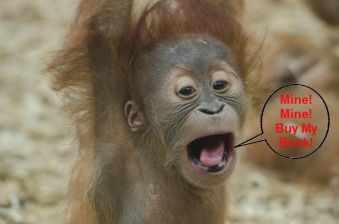
buy_mine

Well, I do.

I want to sell my little book as much as any other author, but I don’t want to beg. There has to be a better way than flooding social media with ads.

Thanks to Chris over at THE STORY READING APE for another terrific find. I don’t know where he manages to find so many amazing and informative websites, but I’m so glad he does.

I devoured this one on how to market a book without posting ads by the thousands on Twitter, Facebook or Instagram.

As an introvert, some of these would be difficult for me, but one of my goals for 2016 is to move a little more out of my comfort zone. The first step toward that goal, is participating in a local Author Con in the Spring.

You may not want to use all of her tips, but even one or two of these ideas could be the springboard you’ve been searching for to launch your book.

Are you ready to move beyond social media to promote your book?

Could you do a book fair, meet with a book club or do an interview with the local media?

Or how about my favorite on her list, create a holiday

Click below and read the entire article. Let me know which of her ideas you think have merit.

How to promote a book without using social media by Author Sandra Beckwith

What did you do to market your book? Did it work? 

Talk to us. Inquiring minds want to know.

You can find me on Twitter @jeancogdell, Facebook at jean.cogdell and Amazon.com, stop by and say hey! Please remember to with a click and share this post with your Twitter peeps and Facebook fans.


Should you care about the bestseller list?

Well, duh, yeah. Every writer wants to see their name on that list.

But, it’s not as easy as writing your best story your family has ever read. 

Each Sunday I enjoy reading the Arts Section of the newspaper. And the first page I turn to is the column where the New York Times Best Sellers are listed. I’m always looking to see who made the list. Is it one of my favorites? Is it a newcomer?

The same holds true for the Amazon.com Top 100 List. I love clicking through looking for a good read, when I have the time that is.

Have you given much thought to how a writer actually gets listed on the New York Times Best Seller List? Or The Wall Street Journal or makes the Amazon.com top 100?

Sell lots of books, make lots of $$$$ and voila! Right?

Well, that’s what I always thought. But, seems it’s not that simple after all.

My whole perspective changed after I read this article by Tim Grahl. Not my dreams of making one of these Best Seller Lists mind you, but now I’m not quite so naive. Achieving this goal is ever-changing and cloaked in secrets and mystery by the powers that be and full of intrigue almost as much as a political drama.

top-secret-1076813_640

The NYT closely guards their decision-making process. But apparently it is based on samples from various booksellers across the country.

The WSJ builds their best seller list based on the sales figures they get from Nielson’s BookScan. But, BookScan doesn’t track every purchase. It doesn’t track sales through big box stores like Walmart or online sales like Createspace. Bulk purchases don’t count. Even legitimate ones. Like for a book club or a classroom.

So what should you or I do?

Just keep writing and not worry about best seller lists? I think so. Because this is one of those things that is beyond our control. Kinda like the weather.

However, this is a fascinating read about how the industry works.

THE TRUTH ABOUT THE NEW YORK TIMES AND WALL STREET JOURNAL BESTSELLER LISTS by Tim Grahl

If you have any tips for achieving this monumental goal, please share!

You can find me on Twitter @jeancogdell, Facebook at jean.cogdell and Amazon.com, stop by and say hey! Please remember to with a click and share this post with your Twitter peeps and Facebook fans.

Some rules are made to be broken

And, it seems I break most of them most of the time.

There are two that plagues me like little devils. They pop up in my writing like annoying toddlers and no matter how many times I rearrange them into the proper order, if I turn my back they’ll break out of line. 

But, as my critique partner and anyone else who knows me will tell you, I write like I talk.  And proper is not it. Oops, broke two in one tiny paragraph. I need to get the broom and sweep up a conjunction and stranded preposition

broken_letters

Conjunctions plague me as do prepositions.

Too bad I talk as I write. I think it’s more important to connect with the reader than to write every sentence grammatically correct. Now this is just my personal opinion. As I’ve mentioned many times, I’m no expert. 

Reading something that sounds stilted and phony pulls me out of the story. 

You wouldn’t ask your spouse, “Honey, what were you talking about on the phone?” No you’d be probably say something more along the lines of, “Honey, what was that about?” Nor would I.

If the word fits the scene then is it okay to break a grammar rule? 

What do y’all think? 

Do you think it’s okay to begin a sentence with a conjunction, or to end a sentence with a preposition?

As you can read in the following article written by . Many famous authors have stranded or dangled a preposition to no ill effect. 

Click and read the entire article and see if there are times when it’s okay to break a few rules.

Can you end a sentence with a preposition?

I’m curious.

Is there a grammar rule that you stumble over?

Which one?

You can find me on Twitter @jeancogdell, Facebook at jean.cogdell and Amazon.com, stop by and say hey! Please remember to with a click and share this post with your Twitter peeps and Facebook fans.

How important are the first words of your story?

Very.

I agonize over the first paragraph more than any part of a story. Sometimes I rewrite it a dozen times and often making it worse before I make it better. 

So how do you start that story?

By grabbing the reader.

death-151527_640

With a whisper and a promise. With fear or joy. You dangle temptation, and offer redemption. The trick is to not start out too big or too fast. It’s like catching a great white shark or blowing up the planet, too much momentum can leave the reader with nowhere to climb. Often a sense of let down or exhaustion hits midway through the book. 

I once read that the writer needs to give the reader a reason to suspend their disbelief and they will gladly go along for the ride. No matter how far-fetched the story all they need is a reason and they will keep reading.

direction-1033278_640

That reason could be a killer opening line. A likeable character or character they love to hate.

 believes that the seeds of that triumph or defeat are sown by the end of the very first sentence. Read his post and see what he says about starting a story.

10 Ways to Start Your Story Better By:

Darcy Pattison wrote a book START YOUR NOVEL in which she lists twelve ways to start novels and give examples of the top opening lines of all times. In the following post she looked at the Top selling books for the week ending August 9, 2013, opened their stories. One contemporary author opened her story with dialog. To read more click: 

10 WINNING WAYS TO OPEN YOUR NOVEL By Darcy Pattison

You can find me on Twitter @jeancogdell, Facebook at jean.cogdell and Amazon.com, stop by and say hey! Please remember to with a click and share this post with your Twitter peeps and Facebook fans.