Should content trigger emotion?

Whether I’m writing a story, novel, or blog, I try to trigger an emotional response from the readers.

Big or little I hope my readers feel something other than boredom.

I love it when I become totally lost in a book, movie or TV show. Don’t you?

Time stands still or flies by on the winds of a hurricane. And when I reach the end, I sit back and savor the story. Full and content as if I’d just dined at a fine restaurant.

One day I hope to write something that captivating. Because nothing is worse than boring my readers.

I want my readers to feel something, fear, embarrassment, curiosity, hate, love, or disgust. Anything is better than nothing.

So, what is it that makes some stories better than others?

Fascination!

  • Is the power to hold somebody’s attention completely or irresistibly.
  • Something that inspires great interest.
  • To be completely absorbed in something interesting
  • To charm, enthrall, or lure.


listThat’s my goal! To write a story that holds a reader’s attention totally.

So what ignites such fascination?


Head over to Copyblogger.com and read how to use the magnetic force of fascination.

7 Steps That Will Hook Your Audience through the Magnetic Force of Fascination by  

Tell me….

How do you fascinate your readers?

How do you stir emotion in the words you write?

You’ve made it this far so take a few seconds and share with me your tips for writing with emotion and fascination.

Please share this with your Facebook and Twitter friends.
Thank you!
If you’re not already, I’d be much obliged if you would follow me @jeancogdell on Twitter or jean.cogdell on Facebook!


How to say I’m sorry

My apologies, I regret, please forgive me, I’m sorry….

Well, you get the gist, but I’m totally sincere.

I’m sorry for limiting my request to those of you who have small children in your household.

As one of my readers pointed out that I was a bit shortsighted with my previous request for Beta Readers. And she was so right. Just because a person may not have small children in or around the house doesn’t mean they cannot recognize the good/bad/ugly/silly/mistakes in a children’s book.

Now with hat in hand, I’m asking for ANYONE who is willing, to be a Beta Reader for my small book.

If you can help this writer out, please email me at jeanswriting@jeancogdell.com and I’ll forward you an e-copy or a pdf copy.

If you missed yesterday’s post, here is a bit about my project.

About my book:

The story is about a little boy named Ben, who doesn’t believe he is any good at sports. Growing up in the shadow of an older sibling, who is a star athlete, can be difficult.

At the insistence of his parents, Ben discovers he can do anything if he tries and in the process make new friends.

This book is for young readers, between the age 7-9 yrs old and Grades 2-3, who are bridging the gap between early readers and chapter books.

PS

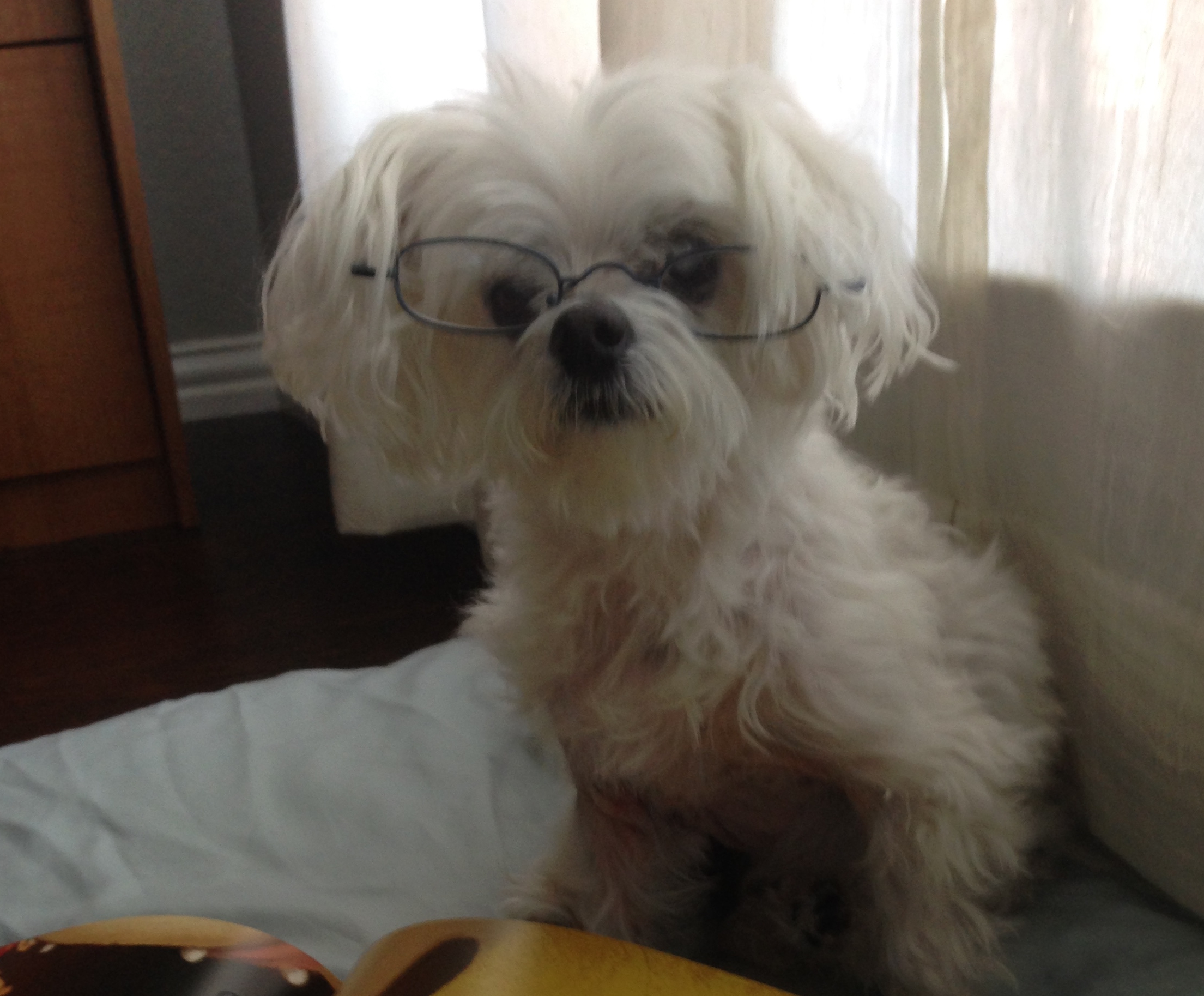
Although Harry tried, I’m not sure he’s up to the task. I tried, one bark for good, two barks for bad and a growl for mistakes. He just played dumb. Like he didn’t know what I was talking about.

Harry in glasses

You’ve made it this far so give me just two more seconds and hit Facebook and Twitter and share.
Thank you!
If you’re not already, I’d be much obliged if you would follow me @jeancogdell on Twitter or jean.cogdell on Facebook!

Are you ready for prime time?

Well, I’m not, not yet anyway.

Getting ready to release on the world has more steps than stitches in a quilt.

Or so it seems. As I type this post with trembling fingers I’m moving on to the next step.

Beta Readers.

Someone once told me to never fear asking.

She said, “What’s the worst that can happen? You already have a no.”

I try to remember her advice. It comes in handy when I need to boost my nerve, like today.

My children’s book may not be ready for prime time yet, but after going through one editing process, it’s time to move on to the next stage­ with Beta Readers.

According to the glasgowdragonfly there is a beta reader selection methodology. Who knew? Anyway, she gives 10 things to remember when searching for Beta Readers.

If you are considering Beta Readers, I recommend you read her article before starting.

10 THINGS TO CONSIDER BEFORE USING BETA READERS

Okay, #1 – done, #2 – I’m breathing, so on to #3 – Searching for independent feedback.

Because you guys were so helpful with cover suggestions, I’m turning to you again.

I’m looking for Beta Readers who have children, or grandchildren between the ages of 6-10.

So if you can help a writer out, please email me at jeanswriting@jeancogdell.com and I’ll forward you an e-copy or a pdf copy.

Now, next I must decide what to ask.

After reading umpteen suggestions on what to ask, I’ve come to the conclusion the questions should be tailored to the project. Just like each genre, story, or writer, no size fits all.

But some of the articles I found were very helpful. But, never fear I’ll keep my request short and simple.

Questions for Your Beta Readers by Jodie Renner

In Ms. Renner’s article she gives us feedback from several of her clients. Here I think you’ll find questions to work for any genre.

Ten Questions to ask a Friend Who Just Read Your Novel by Lydia Netzer

Okay, give me a shout-out if you’re willing to read my little book. 

About my book:

The story is about a little boy named Ben, who doesn’t believe he is any good at sports. Growing up in the shadow of an older sibling, who is a star athlete, can be difficult.

At the insistence of his parents, Ben discovers he can do anything if he tries and in the process make new friends.

This book is for young readers, between the age 7-9 yrs old and Grades 2-3, who are bridging the gap between early readers and chapter books.

A Quick Guide to Beta Reader Etiquette by K.M. Weiland


Harry_reading
Thinking of asking Harry to be my first Beta.

You’ve made it this far so give me just two more seconds and hit Facebook and Twitter and share.
Thank you!
If you’re not already, I’d be much obliged if you would follow me @jeancogdell on Twitter or jean.cogdell on Facebook!


When do you turn loose?

When do you turn loose of your story?

I’m wrestling with this very question.

I thought I was finished with my children’s book, but now I’m not so sure.

How do you know, enough is enough?

Late at night, new ideas and thoughts slip though my tired fogged brain. Doubts that maybe, just maybe I should rewrite or at the very least add more to the book before I turn it loose.

Sigh, letting go is harder than I thought it would be. I expected to feel a sense of accomplishment. Instead, I want to tweak it more and more.

When do you know to type “The End?”

Suw Charman-AndersonCONTRIBUTOR at Forbes wrote, “the problem is knowing when to put the pen down and stop tinkering.”

When Has Your Book Finished Cooking?

This is so me!

I really like this suggestion by Shannon Deaton at

“When a writer can audibly read a draft from beginning to end without stumbling, choking, or otherwise crying, it’s okay to stick a fork in it–the writing’s done, and it’s time to enjoy the sweet desserts of publication.”

Yes reading the story aloud is important, but this made me think about reading as if I were performing. Hmm….

Read more of his article at CIRCLE AVENUE FICTION.

Over at the Positive Writer Bryan Hutchinson suggested the writer should write 10 scenarios. At first glance I thought no way, but his article got me to thinking.

How To Edit Your Book Until It’s “Finished”

He also suggested sending the manuscript out to 30 readers.

paper_the_end

So, how do you know when it’s time to release your baby out in the cold, cruel world?

You’ve made it this far so give me just two more seconds and hit Facebook and Twitter and share.
Thank you!
If you’re not already, I’d be much obliged if you would follow me @jeancogdell on Twitter or jean.cogdell on Facebook!