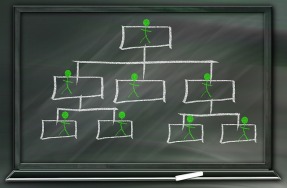
Should you write a fancy outline for your novel?

Maybe- Maybe not.

chart 1

It’s your book, you make the rules.

Different strokes for different folks. Me, I’m trying to be more organized in my writing this year. Only time will tell if I’m successful. LOL

However, I find outlining is a bit of a mystery. spirit-1272923_640

Outlining an unwritten book is weird because you don’t know what will happen. It’s not the same as outlining a book read for a class assignment. No the formal process of outlining a book idea is as foreign to me as Spanish or French. I know just enough to embarrass myself.

Last week I announced to my friend, with much excitement,  I’d finished outlining my first novel. I was stumped for a second when she asked me how many levels I used. Huh? Levels? Like in… I, A, 1, a, ii….

None. Nada, zip. I didn’t use any. Instead, I let the story unfold in my head and then put it to paper one scene at a time. 1-30.

Late at night, I lay in bed and the characters drove me nuts until I added another scene to the list. That’s how I outlined. Nothing fancy. Just one paragraph at a time. Also known as the headlight method.

night-ride-272561_640

Today, outlines are much more fluid than the rigid things we studied  in school many moons ago. In fact, if you Google how to outline a novel you’ll find just about as many ideas on outlines as stories on the latest TV personality.

Writing is like driving a car at night. You can only see as far as the headlights, but you make the whole trip that way.

E.L. Doctrow

Take your pick. Old school (traditional), Synopsis, Scrivener, Snowflake, Headlight method (yeah some weird names), Mind mapping, Sticky notes, Scratch pads, 3 acts, and the list goes on. Don’t let the idea of making an outline intimidate you. If you want to try just pick what works for you and run with it.

However if you just want a guideline to keep you from driving off in a ditch you might try my idea.

  • First: Open up your program, whichever you choose to use. Scrivener or Word, list your chapters, and then let the story begin to play in your head.
  • Next: Begin to write brief notes about what will happen.
  • Then: Step through each numbered chapter until you reach the end.
  • Now you’re ready to let your freak fly!
  • Go to the beginning and start writing. Use the numbered paragraphs as a map for when you get lost or veer too far off the path.

Do you outline?

What type of outlines do you use?

Or are you a pantster?

Keep reading – Great articles at the bottom of the post!

I’d love to hear from you! Click the write me tab or contact me onTwitter @jeancogdell, Facebook at jean.cogdell and Amazon.com, stop by and say hey! The lights are on and I’m waiting.

Please remember to share this post with your Twitter peeps and Facebook Facebook fans.

How to Outline a Novel- The Headlight Method

Outline Your Novel in Thiry Minutes

PLANNING TO OUTLINE YOUR NOVEL? DON’T

How to Outline a Novel (Even If You’re Not an Outliner)

Plot outline creation: 7 smart methods

Today I’m thrilled to congratulate my favorite ape

And a hard-working ape he is!

Congratulations Chris to you and your sister! What a lovely gesture to your mother.

So all you writers/readers pass on the Ape’s good news.

A book is born!

Click on the following link and read the Ape’s story.

NEWSFLASH – Story Reading Ape Publishes Book…

Click image to read a sample…

I’d love to hear from you! Click the write me tab or contact me on Twitter @jeancogdell, Facebook at  jean.cogdell and Amazon.com, stop by and say hey! The lights are on and I’m waiting.

Please remember to share this post with your Twitter peeps and Facebook Facebook fans.

Thanks for keeping me on my toes

Today’s thank you goes to John Maberry, gentleman from N. VA, author, lawyer, and former government employee. Let’s not hold the last two against him. I’m sure those experiences are good fodder for a writer.

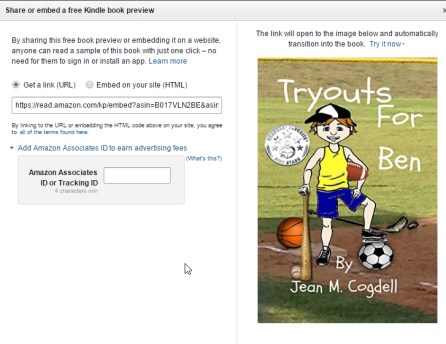
John pointed out that I left a few important tidbits in my post about the new Amazon “Instant Preview” for books.

Oops! He’s right and I’m sorry.

Here’s what I forgot to mention.

1. You can earn additional money.

Add your Amazon Associates ID  to your book preview and you earn advertising fees. You read that right!

screenshot_Thu_Jun_30_14.39.38

Once you plug-in your Amazon Associates ID, you’ll see Link updated with ID under the box. So make sure you sign up and add your ID to the link. Every little bit helps!

2. This works on all ebooks.

Not just Kindle Unlimited. Tryouts for Ben is not listed with KU but when you click on this link, viola an “Instant Preview” opens. Wow!

3. Add your Associates ID to any book you “imbed.”

That’s right, you will receive advertising fees for helping out fellow authors. Writing a book review, add an “Instant Preview” with your ID and share the love!waiting westmoreland


Tell me, have you signed up for an Associates ID?

Do you remember to use it?

Big thanks to John for the heads up! Y’all stop by John Maberry’s Writing Website and say hey. Tell him Jean sent you.

I’d love to hear from you! Click to write me or contact me on Twitter @jeancogdell, Facebook at  jean.cogdell and Amazon.com, stop by and say hey! The lights are on and I’m waiting.

Please remember to share this post with your Twitter peeps and FacebookFacebook fans.


If not, now you may need one in the future.

So get prepared for your —

Beta Readers. fish-bowl-846060_640

Yes, you read that right. Plural, you’ll need more than one.

Why? Because beta readers are different from editors or critique partners. They are readers. But they are an invaluable tool for a writer.

That’s why I’m passing on a great post by Jo Robinson as well as a couple of other great posts on the subject. Check out the links below.

Although, a beta reader can and should point out glaring typos and comma splices, that’s not their primary purpose.

No, the primary purpose of a beta reader is to give you a reader’s perspective of your book, what they might see and think.

A beta reader reads like a consumer not an editor.pennies-15402_640

With that in mind, I’d like to add my two cents.

Make sure you are clear on what you expect from the beta reader. Make a list of questions you’d like answered, but don’t make it too long. You don’t want it to look like a college assignment. There are a few basics every writer wants to know, but maybe you are looking for a particular reaction. If so make sure you ask a question that would reflect it.

Here are a few questions to get you started.

  1. Did the story hook you?
  2. How far into the story before you were hooked? 1st paragraph, 1st page, 1st chapter?
  3. How quickly were you anchored in the story? Or did you get lost in a maze?
  4. Did you relate, understand the characters?
  5. Which character stood out the most?
  6. Could you envision the characters and settings?
  7. Any discrepancies or inconsistencies of details? Descriptions, sequences, places, details? (House on wrong side of road, hair color changed along the way)
  8. Does the story and writing style fit the genre or age group aimed?
  9. Did you skip ahead through any parts? Where?
  10. Did you savor any passages? Where? Why?

Have you ever used Beta Readers?

What was your experience?

Want more questions? Go to the bottom of this post for a link to 15 more.

I’d love to hear from you! Click to write me or contact me on Twitter @jeancogdell, Facebook at  jean.cogdell and Amazon.com, stop by and say hey! The lights are on and I’m waiting.

Please remember to share this post with your Twitter peeps and Facebook fans.

BETA READERS by JoRobinson

What the Heck is a Beta Reader? Do I Need One?   by SHEILA M. GOOD

15 questions for your beta readers – and to focus your own revisions by Jodie Renner