Writing with Gerunds

G = Gerunds

Writers new and old sometimes stumble over writing with  Gerunds.

Do you know the correct way to write with Gerunds?

Not all of these “ing” Devils are bad. This is a writing tip worth repeating. A reminder that I make sure the “ing” action matches the rest of my sentence.

“Running home she flung open the front door.” Hmm… This needs work.

Want to rid your writing of a few of these scary little Gremlins?

Head over to The Kill Zone’s post titled Gerunds Be Gone, for examples for writers.

For additional help, you might want to check out editing software Grammarly Ginger and ProWritingAid. I use all three.

Ready to go Gerund hunting?

Elmer hunting

Read the post over at Writing-World. com for more help.

Click the link for more details on the  A to Z Challenge

Talk to me, I love reading your comments.

Please head over and “like” my Facebook page at Facebook at jeanswriting . Or to connect with me, click the “write me” tab. Don’t forget you can follow me on StumbleUpon,  on Twitter @jeancogdell , and Amazon.com.

Please stop by and say “hey!”  I’ll leave a light on. 


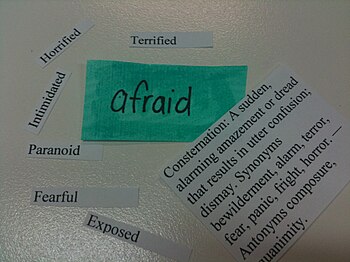
Put fear in your writing

Fearmongering

To deliberately arouse fear, awe or alarm.

Think of your story as a news broadcast. A news anchor peppers each story with fearmongering. Why? To get and keep you tuned in and watching. And let’s not forget the politicians or their ads.

Look at your WIP and find places to interject fear words.

Fear is a powerful emotion used to grab your reader’s attention. Go for the jugular.

Fearmongering keeps the pace tight and moving.

Below are just a few fear words. Listen to the news tonight and see how many you count in tonight’s breaking news.

English: Words associated with Fear
Photo credit: Wikipedia)

Agony, Assault, Backlash, Beating, Beware, Blood, Bomb, Catastrophe, Caution, Corpse, Crazy, Danger, dead, Devastating, Embarrass, Fail, Fired, Fool, Frantic, Hazardous, Horrific, Invasion, IRS, Jail, Lawsuit, Looming, Lurking, Meltdown, Mistake, Murder, Nightmare, Painful, Panic, Plague, Poison, Revenge, Risky, Scary, Scream, Shatter, Suck, Tailspin, Terror, Trap, Victim, Volatile, Warning, Wounded

Want them to remember your writing?

Exaggeration

Want your readers to come back for more then…

Make your characters and scenes appear more. More of everything.

  • More common, or more important, more of what is true or usual.
  • Overstate the obvious, mundane, and ordinary until your words are extraordinary.

With the letter D, I explained how I to build characters, scenes and even sentences little by little.

Today I’m writing about the reverse.

Write every sentence, every paragraph with grand embellishment. Then cut the to make palatable.

Exaggerate your writing to the point of extreme and then pare it to almost the believable.

Why? Because…

  • The jokes you remember and retell are the most outlandish.
  • Hit TV shows that skirt the ridiculous.
  • We even remember terrible and the beautiful.
  • The unbelievable, outrageous, scary movies you watched years ago, still give you the creeps.
    • Can anyone say Psycho?

I still don’t like to shower unless I can see through the curtain.

Michael strutted in owning the place, six-feet of Cowboy oozing pure testosterone, his dark curls falling over to die for chocolate eyes that zeroed in on me flushed and sweating like a whore in church.  

Okay, that was a long, silly sentence, but I bet you could picture Michael. A handsome, cocky Devil. Whew, getting hot in here…

thankyou note card

D: Description

Blogging  A TO Z CHALLENGE

D is for Description

Doesn’t matter where you write by plot or the seat of your pants. The Devil is in the details.

For me I write in waves. First draft is with broad strokes. With each pass I add more details to the scene and characters. Soon the road through my story gets bumpy.

Turning Flat Stanley‘s into flesh and blood characters.

“Mitchel was about six feet tall, and under two-hundred pounds.” This is a generic description. I know he is tall, dark and handsome, with eyes the color of dark chocolate. He has cute love-handles that roll over his belt, which are the results of too many home-cooked meals by his new bride. But my reader doesn’t see what I see, hear what I hear, or know him very well until I reveal the picture and turn on the audio.

To introduce him to my readers, I must give him life. Somehow I must depict not just his features and statistics.

What is he doing, saying? Is he moving or standing still? For the reader to understand the character, he must live. A little bit like Dr. Frankenstein, we as writers take bits and pieces to create something from nothing.

With each draft, I add more, until fingers crossed, my characters and scenes are visible to my reader.

I want to avoid…

  • Laundry lists of descriptions. (Blond hair, blue eyes, age 45 etc.)
  • Cliches that make characters appear like caricatures.

How…

  • by combining descriptions with actions, emotions, or thoughts, allowing them to do double duty.

For help with writing descriptions check out…

The Art of Description

The Art of Dynamic Descriptions

Use Vivid Description

thankyou note card

How do you give life to your characters and scenes? Do you have all the tiny details mapped out from the beginning?