Posts

How to avoid being a question junkie

Don’t ask too many questions.

We’ve heard it many times, “There are no stupid questions.” 

Image Source

Teachers tell this to their students, and parents to their kids all to encourage curiosity. But, sometimes we need to stop asking and start writing.

Image Source

My name is Jean, and I’m a “question” junkie.

Maybe I’m all alone in the world, I hope not. But here is how I became hooked on questions. It first started with “what about.”

I started a novel around a couple of years ago when up popped “what about.”

What about a cute little girl book? After all, I’d already written one children’s book, Tryouts for Ben. Made perfect sense to write another.

Ooh, yeah I can do that. So I set aside my novel and wrote A Most Reluctant Princess.

The results were everything I’d hoped. Happy and satisfied I went back to work on my novel. Well, you guessed it another “what about” reared its head and I bit.

What about a cute little boy book to mirror the little girl book?

Great idea! I’d written a picture book so it shouldn’t take as long to write another. Wrong, it did.

I finished A Reluctant Little Prince and couldn’t be more proud.

Image Source

So back to my novel I went. And this time I’m on fire,  burning up the keyboard.  Until you guessed it, another question appeared, and I couldn’t resist.

Hmm, can’t find a journal you like, then “what about” introduced me to his younger brother “what if.”

What if suggested I take a break from the novel and write my own journal. Cool idea!

Okay, wrote and published my journal. Looked pretty damn good too. I’m psyched, ready to get back to my novel, the ideas are popping around in my head like Orville Redenbacher.

Image Source

But “what if” was just getting started.

Did I mention all the ideas popping around in my head? Well, every time I’m on a roll, typing and talking to my characters, “what if” buts in with another thought. What if this or that happened? It could be interesting.

Next thing you know, I’m off chasing squirrels with my characters. If I keep this up, they’ll develop personality disorders, and I’m gonna have to spring for a psychologist. Not sure where I could fit a shrink in the plot. Hmm, wait a minute maybe if

I understand that “what if” and “what about” and other questions are useful tools for writers. They help us move from scene to scene, but these dudes are driving me batty. I need a little quiet to finish what I’ve started.

Thanks for listening. It felt good to clear the air. Now I need to go comfort my protagonist. At this point, she’s unsure whether to save or kill someone in this chapter.

Anyone else with these writing issues?

Do the abundance of possibilities give you whiplash?

Any other junkies that get bogged down with questions?

PS: Sorry about all the Gifs

But as I was writing this post “what ifs” cousin, “look how cute” dropped by. Sigh… I really must do some writing today.

Keep reading – great links ahead about good questions for writers.

Leave me a comment – I love comments.

Please head over and “like” my Facebook page at Facebook at jeanswriting . Or to connect with me, click the “write me” tab. Don’t forget you can follow me on StumbleUpon,  on Twitter @jeancogdell , and Amazon.com.

Please stop by and say “hey!”  I’ll leave a light on. 

5 Key Questions to Ask as You Write Your Novel

Novel Writing: 10 Questions You Need to Ask Your Characters

7 Questions to Ask Yourself as You Write Your Novel  

Do you think it’s important to hook fast?

A reader that is.

How soon should a reader expect to feel the tug of a hook? That ah-ha moment that keeps them turning the page?

boo-1295226_640

First paragraph, page, or chapter?

At times I’m a bit of a perfectionist. I’ll mess with an opening until I feel that tug myself. Then I can continue writing. Often I’ll rewrite the beginning of a story a dozen times before I feel happy with it. I’m not talking about grammar mistakes. Those are easy fixes by an editor. I’m talking about that “feeling.”

There are a lot of do’s and do not’s but the most important rule to me is “feeling” that tug. That knowing hook.

I’ll be buzzing right along in the middle of a scene when bam, I know something is wrong. The line broke. I have to go back and fix my hook and bait. Wiggle the line until once again I feel that familiar tug.vintage-1817338_640How about y’all? Do you write until the opening tugs at you to go on or do you just wing it?

As always I’ve left you some great reading at the bottom of my post. Let me know what you think.

Leave me a comment – I love comments.

Please head over and “like” my Facebook page at Facebook at jeanswriting . Or to connect with me, click the “write me” tab. Don’t forget you can follow me on StumbleUpon,  on Twitter @jeancogdell , and Amazon.com.

Please stop by and say, “hey!” I’ll leave a light on. 

How to Find the Start of Our Story

10 Ways to Start Your Story Better

How to Set Up a Story’s Hook

The 21 Best Tips for Writing Your Opening Scene

Image Source from Pixabay.com 

Are you ready for the unvarnished truth?

About blogging?

road-humps-ahead-246_960_720Not many of us know what lays ahead of us when we begin blogging. The bumpy road is a surprise and we are never ready for all the strange things we encounter.

However, the following post The Ugly Side of Blogging by Elena Peters, is a must read for anyone ready to take the blogging plunge. Or a confused blogger.

Ms. Peters lists 21 truths about blogging that many of us didn’t see coming before we were hit like a truck running a red light.

deceive-1299043_960_720
Image Source
  • #4 – Please, I have fiddled with my format, theme, and pictures so much this blog had an identity crisis to rival Sibil.
  • #5 – As a writer, don’t most writers think about quitting every single day? Maybe it’s just me.
  • #7 & #15 & #17 – Lies, Free & Trust. Oh yes. The internet is floating in lies, freebies, and people to be trusted. Right, best keep a lifeboat handy when you launch into the deep waters of blogging. And one last thing, before you pay big bucks for a writer’s course, make sure it’s sold by someone who as actually written a good book.

I enjoy blogging. It’s fun to put my thoughts out in the world and see what pops back to me but I’m not making any money. That would be lovely but not necessary.

Now selling my books, that’s a different balloon of another color. I’d love to make money with my books.

Did any of Ms. Peters “truths” speak to you?

Which ones?

Any surprises?

Have you been burned since you began blogging? How?

Leave me a comment – I love comments.

Please head over and “like” my Facebook page at Facebook at jeanswriting . Or to connect with me, click the “write me” tab. Don’t forget you can follow me on StumbleUpon,  on Twitter @jeancogdell , and Amazon.com.

Please stop by and say, “hey!” I’ll leave a light on. 

To delete now or later that is the question.

One question of so many!

question-1015308_640
Image source

Last week I read a post by one of my fav authors What Am I Working On? Glad You Asked…. His post got me

My internal editor is never quiet.

I go back over and over a chapter, too many times I’m sure before I can continue. Makes my writing process slow as molasses.

What was it about Dan’s post that caught my eye?

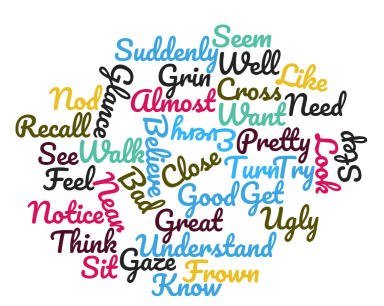
Crutch words. Or some of you may know them as filler words.

crutch-words

Dan let his manuscript rest for a year before beginning the editing process and culling out crutch words. Now that’s what I call discipline.

It’s not bad to use these words. They make great place holders for an idea, thought or dialog. However, too many a story makes me look more of an amateur than I am. Don’t know about you but I want my book to appear as polished as possible.

  • So just how do we find crutch/filler words? See, told you I had more questions.
    • Use a word counter to find words used too often as well as adverbs and repeated phrases. Look at the numbers. As all accounts know, numbers don’t lie.
  • How do we replace them? And with what?
    • After you locate the offending words/phrases, decide if a word adds or detracts to your sentence/paragraph. If the story isn’t altered by deleting the words, then you are on the right track.
  • Why should we change them? 
    • Crutch/filler words make our writing lazy. They detract from the flow and crisp dialog. And in some cases, are down right irritating to the reader.

Writers Helping Writers has a great tip sheet of crutch words. [PDF]Crutch Words – Writers Helping Writers. Check out their website for additional writing tools and books.

So tell me, am I the only writer that gets bogged down with editing too soon?

Do you edit as you go or wait as Dan did?

Are you able to silence your internal editor and get the job done?

Sorry if I sound like a two-year-old with all the questions but I’ve got a curious mind. LOL

As always I’ve listed a few articles at the bottom of this post to aid your process.

Leave me a comment – I love comments.

Please head over and “like” my Facebook page at Facebook at jeanswriting . Or to connect with me, click the “write me” tab. Don’t forget you can follow me on StumbleUpon,  on Twitter @jeancogdell , and Amazon.com.

Please stop by and say, “hey!” I’ll leave a light on. 

Keep reading!

How Crutch Words Are Holding Back Your Writing

How to Identify your Crutch Words and Highlight Your Style