Posts

How to be a good writer with style? Learn from a successful one.

Here’s another one on great writers.

Have you found your style? 


I’ll confess right up front, I’ve struggled with voice and style since I began writing. Writing as myself, sounding like me and hoping people enjoy it seems at odds. After all, my mind is a mystery to myself, so how in the world could I expect anyone else to understand my thoughts.

Forgive the rambling. Sometimes I get carried away.

Now back to writing with style.

StumbleUpon is becoming one of my favorite places to find great reading on the craft of writing. Once again I stumbled upon an article about Kurt Vonnegut and his tips on writing with style.

Vonnegut: How To Write With Style by Eli James

In this article, Eli James lists seven things to help a writer zero in on their style.

Here are my thoughts:

  1. Find a subject you care about
    • Now I care about a lot of stuff. Hmm, gonna have to work on narrowing this down a bit more.
  2. Don’t ramble
    • Oops, I have really gotta work on this one. My apologies folks.
  3. KIS
    • Simple. Short and sweet. Sometimes I take that too far. Another point to work on.
  4. Cut
    • Eli says we must have the guts to cut words and sentences we love. Doesn’t move the story forward, gotta go. No matter how beautiful. Oh well.
  5. Sound like me
    • Write like me, not anyone else. Guess, I shouldn’t try and kill that Southern twang I’ve got going.
  6. Say what you mean
    • Unless writing fantasy, SF fiction where the language is not of this world use words that readers will understand.
  7. Pity the readers
    • Now I admit this one gave me pause. I understand it to mean, write with the reader in mind. Know your audience.

Are you happy with your writing style? Or are you still searching?

Could you learn something from Kurt Vonnegut?

Who do you write like? Click here and find out. I write like…

More reading at the bottom!

Talk to me – I love reading your comments.

Please head over and “like” my Facebook page at Facebook at jeanswriting . Or to connect with me, click the “write me” tab. Don’t forget you can follow me on StumbleUpon,  on Twitter @jeancogdell , and Amazon.com.

Please stop by and say “hey!”  I’ll leave a light on. 

Style BY KATHLEEN CALI 

Four Different Types of Writing Styles:  Syed Hunbbel Meer 

Style, Diction, Tone, and Voice Wheaton College

Images courtesy of Pixabay.com 

The Dos and Don’ts to Dialogue Tags

I’m thrilled to welcome Ryan Lanz as a guest blogger today.

Sit back read and enjoy.

The Dos and Don’ts to Dialogue Tags by Ryan Lanz

Writers use dialogue tags constantly. In fact, we use them so often that readers all but gloss over them. They should be invisible. However, there are ways to misuse them and make them stand out.

In an effort to avoid that, let’s take a closer look at dialogue tags. Toward the end of “Tag travesties” is something I sorely wish someone had told me before I started writing.

Why do we use dialogue tags?

The simple answer is that we use them to indicate who’s speaking. In visual media, such as movies or television, the viewer can easily tell who’s talking by lip movement and camera angles. When reading a book, obviously that’s not an option.

Tag travesties

There are certainly ways to misuse dialogue tags. When I was a new writer, I felt compelled to overwrite. I ‘m sure every new writer goes through a version of this. I observed how successful writers used simple tags like “said/asked” and thought to myself, that’s boring. I’m going to be an awesome writer by making them more interesting. You don’t have to admit it aloud, writers, but we all know that most of us have. Let’s look at an example of this:

  • “We can’t cross this river,” Alanna exclaimed repugnantly.
  • John crossed the room and shouted disgustedly, “I’ll never take you with me.”
  • “This has been the worst day ever,” Susie cried angrily.

For those of you who still aren’t convinced, let’s up the dosage with a paragraph:

Hank crossed the room and sat down. “We should have never waited this long for a table,” he seethed, leaning over to glare at her. 
“If you wanted a better spot, you should have called ahead for a reservation,” Trudy returned pointedly.
“Well, perhaps if you didn’t take so long to get ready, I could have,” he countered dryly.

Can you imagine reading an entire book like that? *shiver*

So why do new writers feel the urge to be that . . . creative with their dialogue tags? Back in the beginning, I thought the typical tags of “said/asked” were too boring and dull. It didn’t take me long to realize that dull (in this context) is the point.

Image your words as a window pane of glass, and the story is behind it. Your words are merely the lens that your story is seen through. The thicker the words, the cloudier the glass gets. If you use huge words, purple prose, or crazy dialogue tags, then all you’re doing is fogging up the glass through which your reader is trying to view your story. The goal is to draw as little attention to your actual words as possible; therefore, you keep the glass as clear as possible, so that the reader focuses on the story. Using tags like “said/asked” are so clear, they’re virtually invisible.

Now, does that mean that you can’t use anything else? Of course not. Let’s look further.

Alternate dialogue tags

Some authors say to never use anything other than “said/asked,” while others say to heck with the rules and use whatever you want. Some genres (such as romance) are more forgiving about using alternate dialogue tags. I take a more pragmatic approach to it. I sometimes use lines like:

“I’m glad we got out of there,” she breathed.

The very important question is how often. I compare adverbs and alternate dialogue tags to a strong spice. Some is nice, but too much will spoil the batch. Imagine a cake mix with a liter of vanilla flavoring, rather than the normal tablespoon. The more often you use anything other than “said/asked,” the stronger the flavor. If it’s too powerful, it’ll tug the reader away from the story and spotlights those words. In a full-length book of around 85,000 words, I personally use alternate dialogue tags only around a few dozen times total.

By saving them, the pleasant side effect is that when I do use them, they pack more of an emotional punch.


Related: How to Write Natural Dialogue


Action beats

I have a love affair with action beats. Used effectively, they can be another great way to announce who’s talking, yet at the same time add some movement or blocking to a scene. For example:

Looking down, Katie ran a finger around the edge of the mug. “We need to talk.”

That added some nice flavor to the scene, and you know who spoke. The only caveat is to be careful of not using too many action beats, as it does slow down the pacing a tiny bit. If you’re writing a bantering sequence, for example, you wouldn’t want to use a lot of action beats so as to keep the pacing quick.

Dos and don’ts

Sometimes, action beats and dialogue tags have misused punctuation. I’ll give some examples.

  • “Please don’t touch that.” She said, blocking the display. (Incorrect)
  • “Let’s head to the beach,” he said as he grabbed a towel. (Correct)
  • Sam motioned for everyone to come closer, “Take a look at this.” (Incorrect)
  • Debbie handed over the magnifying glass. “Do you see the mossy film on the top?” (Correct)

Conclusion

Like many things in a story/novel, it’s all about balance. Try alternating actions beats, dialogue tags, and even no tags at all when it’s clear who’s speaking. By changing it up, it’ll make it so that no one method is obvious.
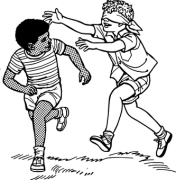
kids blindfolded-37705__340.png

Tag your turn!

What do you think about dialogue tags? 

Do you use a lot of them or stick with the basics?

Leave me a comment and let’s talk tags.

Don’t forget to hop over to Ryan’s blog. You can reach him here…

Ryan Lanz is an avid blogger and author of The Idea Factory: 1,000 Story Ideas and Writing Prompts to Find Your Next Bestseller. You can also find him on TwitterFacebook, and Tumblr

I HOPE YOU’LL TAKE A MINUTE TO FOLLOW ME ON SOCIAL MEDIA, JUST CLICK ON THE BUTTONS BELOW. I’LL LEAVE A LIGHT ON.


Want to be a good writer? Learn from a great one.

Like Ernest Hemingway

This morning as I stumbled along reading posts I found the Positivity Blog, Simple Tips and Habits That Work in Real Life.  What a great concept for a blog. Everyone is looking for things that really work every day.

This particular post was Ernest Hemingway’s Top 9 Words of Wisdom 

Now you may not be a writer, or maybe you are already a successful writer but this article is for everyone. I believe these nine words of wisdom which Mr. Hemingway applied to his life and his writing could benefit us all.

Here is what I gleaned from the post:

  1. Listen more.
    • Be present. How many times have we heard that lately? Seems everyone is attempting to slow down and smell the roses. Some of my best lines came from a conversation I overheard in a restaurant.
  2. Trust yourself.
    • This is very hard for me. But at some point, as a writer, I must trust my writing and the readers. Did I mention this is not easy?
  3. Eyes on the prize.
    • Again, not easy. I have a tendency to get distracted. Busy does not mean moving in the right direction. Multi-tasking is not a talent. Keep writing.
  4. Make writing a habit.
    • Nike once had a motto, Just Do It. Seems I need to adopt this for my writing. What about you?
  5. Attitude is everything.
    • Fake it till you make it. Failure is okay as long as I don’t quit. Get back on the horse that threw me. All right, all right that’s enough platitudes.
  6. When the times are tough, the tough get going.
    • Sorry, had to do one more bit of bullshit, LOL.  But in all honesty, writing is hard so sometimes I have to slough through the hard days.
  7. Don’t sweat the small stuff.
    • I think we all struggle with this concept. But when I think about it will anyone really remember that I left the sink full of dirty dishes last night?
  8. Turn my imagination loose.
    • If I can’t suspend disbelief, how can I expect my readers to? Hmm, food for thought. Gotta mull this one around a little more.
  9. Understand rather than judge.
    • Whoa, that’s deep. Accepting and understanding not only what I feel and think but also the feelings of others. Kinda brings us full circle to #1 (Listen.)

Reading this post tells me that not only was Ernest Hemingway a great writer he was a wise man.

What do you think?

Could this apply to everyday life?

Talk to me – I love reading your comments.

Please head over and “like” my Facebook page at Facebook at jeanswriting . Or to connect with me, click the “write me” tab. Don’t forget you can follow me on StumbleUpon,  on Twitter @jeancogdell , and Amazon.com.

Please stop by and say “hey!”  I’ll leave a light on. 

When is the best time to do your taxes?

Never if you ask me.

But, unfortunately,  it’s that time of year!

At least here in the States. April 18th is drawing near and the tax man is waiting. And like dirty laundry a task that cannot be avoided.

If you haven’t filed your taxes maybe you could use a little more information. Thanks to Jane Friedman for sending writers a terrific bunch of tips to make this arduous task a little less painful.

Mine are filed! Whoo hoo!

What did I learn from reading Jane’s post?

  • I don’t have to make a profit to take deductions.
  • Expenses for my books and website are just that “expenses.”
  • I don’t have to have employees to have a business. Just me.
  • Keep good records. (Glad I use Quicken.)
  • Amazon will report your royalties, make sure you include them on your returns.

What Every Self-Published Author Needs to Know About Taxes

After you’ve read Jane’s post and tell me…

Have you done your taxes yet?

Did you include your writing profits/losses?

Did you learn something new from Jane’s post?

Tell me,  I love reading your comments.

Please head over and “like” my Facebook page at Facebook at jeanswriting . Or to connect with me, click the “write me” tab. Don’t forget you can follow me on StumbleUpon,  on Twitter @jeancogdell , and Amazon.com.

Please stop by and say “hey!”  I’ll leave a light on.

More interesting reading

Tax Deduction Tips for Writers

A Tax Cheat Sheet for Kindle eBook Self-Publishing

Images courtesy of Pixabay.com