Do you know how to convert premise to plot?

Don’t know about y’all, but I still struggle with premise vs plot every time I start writing.

Each time I think I’ve got a lock on the difference, and guess what? Turns out I don’t.

I can come up with a lot of ideas (premise) but turning one of those ideas into a full-grown plot more often than not, slips through my mind like water through a sieve.

When I read a good article, book or post on premise and plot, I latch on like a hungry baby with a bottle and reach out to share with y’all.

UpcomingEvents (1)According to Roz Morris, over at Nail Your Novel, I need to take my idea/premise and covert it into events. Events that need a sense of change. The events must matter to the characters be irrevocable, present them with dilemmas and push them out of their comfort zone.

Her explanation puts the concept of premise in a whole different light.

Ms. Morris even gives examples of what type of events, from larger than life, extraordinary earth shattering events to more subtle life choices. Or a mixture of both.

She suggests I treat the premise as an environment, with interesting challenges and an exciting route.

What do these events need to advance the story?

  • A sense of increasing pressure
  • A sense of urgency and complication
  • Events that challenge the characters in uncomfortable ways, revealing their true nature.

Her post helped me see how to advance my premise into a real story.

Hope it helps you guys too. Click on the link and read her entire article.

Self-editing masterclass snapshots – do you have a plot or a premise? by Roz Morris

You’ve made it this far so give me just two more seconds and hit Facebook and Twitter and share.
Thank you!
If you’re not already, I’d be much obliged if you would follow me @jeancogdell on Twitter or jean.cogdell on Facebook!


I can’t thank you enough!

A big thanks to you guys who offered to read my little children’s book.

It’s still not too late to be a Beta Reader for me.

The book is short, so it shouldn’t take long.

And thanks for all the suggestions about the cover.

I’m still considering using a pro designer.

However, this is my latest cover based on your suggestions.

cover_300_

A big thank you!

I’m beginning to understand raising kids is not the only thing it takes a village to raise.

Should content trigger emotion?

Whether I’m writing a story, novel, or blog, I try to trigger an emotional response from the readers.

Big or little I hope my readers feel something other than boredom.

I love it when I become totally lost in a book, movie or TV show. Don’t you?

Time stands still or flies by on the winds of a hurricane. And when I reach the end, I sit back and savor the story. Full and content as if I’d just dined at a fine restaurant.

One day I hope to write something that captivating. Because nothing is worse than boring my readers.

I want my readers to feel something, fear, embarrassment, curiosity, hate, love, or disgust. Anything is better than nothing.

So, what is it that makes some stories better than others?

Fascination!

  • Is the power to hold somebody’s attention completely or irresistibly.
  • Something that inspires great interest.
  • To be completely absorbed in something interesting
  • To charm, enthrall, or lure.


listThat’s my goal! To write a story that holds a reader’s attention totally.

So what ignites such fascination?


Head over to Copyblogger.com and read how to use the magnetic force of fascination.

7 Steps That Will Hook Your Audience through the Magnetic Force of Fascination by  

Tell me….

How do you fascinate your readers?

How do you stir emotion in the words you write?

You’ve made it this far so take a few seconds and share with me your tips for writing with emotion and fascination.

Please share this with your Facebook and Twitter friends.
Thank you!
If you’re not already, I’d be much obliged if you would follow me @jeancogdell on Twitter or jean.cogdell on Facebook!


How to say I’m sorry

My apologies, I regret, please forgive me, I’m sorry….

Well, you get the gist, but I’m totally sincere.

I’m sorry for limiting my request to those of you who have small children in your household.

As one of my readers pointed out that I was a bit shortsighted with my previous request for Beta Readers. And she was so right. Just because a person may not have small children in or around the house doesn’t mean they cannot recognize the good/bad/ugly/silly/mistakes in a children’s book.

Now with hat in hand, I’m asking for ANYONE who is willing, to be a Beta Reader for my small book.

If you can help this writer out, please email me at jeanswriting@jeancogdell.com and I’ll forward you an e-copy or a pdf copy.

If you missed yesterday’s post, here is a bit about my project.

About my book:

The story is about a little boy named Ben, who doesn’t believe he is any good at sports. Growing up in the shadow of an older sibling, who is a star athlete, can be difficult.

At the insistence of his parents, Ben discovers he can do anything if he tries and in the process make new friends.

This book is for young readers, between the age 7-9 yrs old and Grades 2-3, who are bridging the gap between early readers and chapter books.

PS

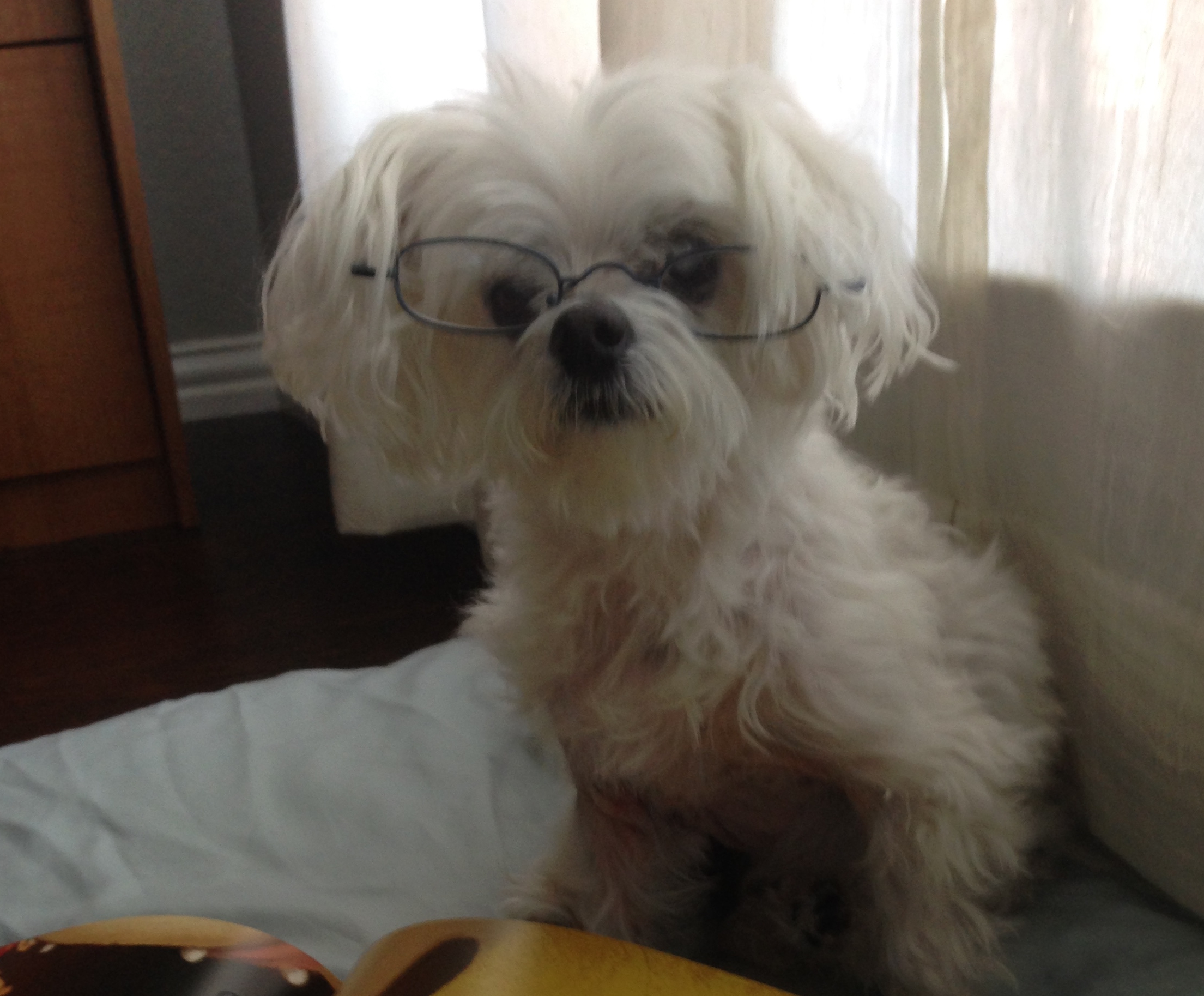
Although Harry tried, I’m not sure he’s up to the task. I tried, one bark for good, two barks for bad and a growl for mistakes. He just played dumb. Like he didn’t know what I was talking about.

Harry in glasses

You’ve made it this far so give me just two more seconds and hit Facebook and Twitter and share.
Thank you!
If you’re not already, I’d be much obliged if you would follow me @jeancogdell on Twitter or jean.cogdell on Facebook!