Then make sure your images are optimized for those all those pesky little search spiders and bots.
No, not gonna scare you with SEO talk. But, if you want to help Google and other search engines find your book or blog, add information to your images.
After reading how a post by Mae Clair over at Story Empire Blog, I realized image information is one more tool used by search engines.
Me burning the midnight oil.
Heading over to fix a lot of my images now. Sigh… may take me awhile.
Find out the importance of adding information to your images. Read…
Writer Angus MacPhail is credited with coining the term, Alfred Hitchcock adopted the word and used it throughout his career.
One way to understand a MacGuffin is to find what, in your story, inspires or motivates the characters.
A MacGuffin can be the goal, object, desire, or gimmick that is of vital importance to the characters. As there are great women behind good mean, there must be something motivating your character to action. MacGuffin is a plot device that gets the story started.
Writers/authors and teachers often disagree on this subject. Some say every story has one or should have one, others say the term MacGuffin was an inside joke between Angus MacPhail and Alfred Hitchcock and shouldn’t be taken seriously.
One example is in the Maltese Falcon. The hunt for the falcon gets the story rolling, but has little to do with where the film ends up. This is a perfect MacGuffin.
Want to read more about MacGuffin? Click on links below.
Sunday’s are when I catch up on my reading. Blog posts I’ve missed or tagged to read are saved for a slow Sunday afternoon. There are so many great bloggers/writers it’s hard to keep up, but I do try.
I’ve been working on dialogue in my WIP, so you can imagine my excitement when I came across not one but two posts by Dan Alatorre on how to make that dialogue great.
Like Dan, I like to bang out the dialogue fast and get the gist down before I lose the flow. Works more times than not.
What I learned from Dan today…
Write like people talk. In my family, the women drive the men crazy talking over each other, no such thing as one-at-a-time.
Don’t forget the beats. Yes, a dialogue needs beats.
A trick to adding those beats, jot down a list of actions to match conversation. Sort of like setting out all the ingredients before baking a delicious cake.
Click on the links below and read allof Dan’s tips and tricks to turn your good dialogue into great dialogue.
Thanks, today goes to Patricia Lynne for ways to substitute the word very.
I don’t know about you but sometimes I get into a very rut. I try not to worry about using words like very when in draft mode. But when it comes time to edit, that word needs to get scarce.
And that’s where Patricia’s cheat sheet comes in handy.
If you’re searching for an expression to explain how very excited (psyched) a character is, check out her post and learn how to avoid very.
Or if you are very tired (weary) of using crutch words you might want to click on OneLook Reverse Dictionary. Just type in the phrase and up pops suggestions. Give it a try and begin your own vocabulary cheat sheet. Excel and Microsoft Word are perfect for making your own list.













 Now tell me, did you learn something new?

 If you’re searching for an expression to explain how very excited (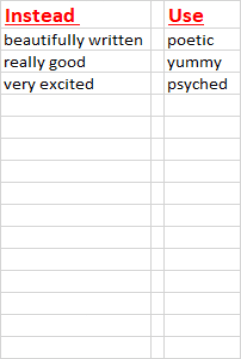


 Jean's Writing