Writing With Intrigue

I = Intrigue

  • cause to be interested or curious
  • Fascinate your readers with words that peak their curiosity.

Sprinkle words throughout your writing that alarm, deceive, or charm the reader.

Getty Images

The mail icon on her computer flashed. Rachel opened the inbox and stared. Line after line from a strange address, concealed by symbols, &?#%$@mail.net. Fifty weird emails, marked urgent family emergency filled the screen. How did this person get her private email address?

Junk mail should’ve gone into the spam box. She hoped the anti-virus software would protect her computer. The cursor blinked, daring her to click. Curiosity was a weakness, all her life she’d heard about the cat dying.

She opened the first email.

thankyou note card

Writing a Better Hook

Writing a good hook is not as easy as it may sound.

Every writer wants to grab the reader by the neck and squeeze.

I’m bad to read the first couple of pages and if I’m not hooked stop reading.

So it stands to reason, that first page or even that first paragraph is the most important part of the story.

Without a good hook, the reader moves on to another book.

H is for Hook

Want to write a great hook?

Keep reading…

Larry Brooks at the Storyfix explains how a writer should reach for a better hook.

Over at WritetoDone is a good article on writing a hook using visualization.

Write it Sideways gives 6 Ways to Hook Your Reader.

A few books that had me from page one…

Delirium (Delirium Series Book 1) [Kindle Edition] by Lauren Oliver,

Wool Omnibus Edition (Wool 1 – 5) (Silo series) [Kindle Edition] by Hugh Howey

The Memory Box [Kindle Edition] by Eva Lesko Natiello,

Outlander: A Novel (Outlander, Book 1) [Kindle Edition] by Diana Gabaldon

Share your favorite reads that grabbed you from the first page, or maybe a book that hooked you but didn’t live up to the promise.

Writing with Gerunds

G = Gerunds

Writers new and old sometimes stumble over writing with  Gerunds.

Do you know the correct way to write with Gerunds?

Not all of these “ing” Devils are bad. This is a writing tip worth repeating. A reminder that I make sure the “ing” action matches the rest of my sentence.

“Running home she flung open the front door.” Hmm… This needs work.

Want to rid your writing of a few of these scary little Gremlins?

Head over to The Kill Zone’s post titled Gerunds Be Gone, for examples for writers.

For additional help, you might want to check out editing software Grammarly Ginger and ProWritingAid. I use all three.

Ready to go Gerund hunting?

Elmer hunting

Read the post over at Writing-World. com for more help.

Click the link for more details on the  A to Z Challenge

Talk to me, I love reading your comments.

Please head over and “like” my Facebook page at Facebook at jeanswriting . Or to connect with me, click the “write me” tab. Don’t forget you can follow me on StumbleUpon,  on Twitter @jeancogdell , and Amazon.com.

Please stop by and say “hey!”  I’ll leave a light on. 


Put fear in your writing

Fearmongering

To deliberately arouse fear, awe or alarm.

Think of your story as a news broadcast. A news anchor peppers each story with fearmongering. Why? To get and keep you tuned in and watching. And let’s not forget the politicians or their ads.

Look at your WIP and find places to interject fear words.

Fear is a powerful emotion used to grab your reader’s attention. Go for the jugular.

Fearmongering keeps the pace tight and moving.

Below are just a few fear words. Listen to the news tonight and see how many you count in tonight’s breaking news.

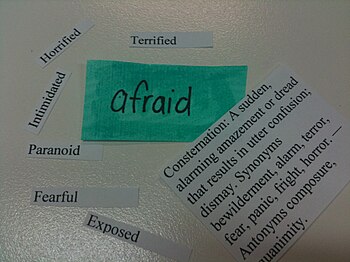
English: Words associated with Fear
Photo credit: Wikipedia)

Agony, Assault, Backlash, Beating, Beware, Blood, Bomb, Catastrophe, Caution, Corpse, Crazy, Danger, dead, Devastating, Embarrass, Fail, Fired, Fool, Frantic, Hazardous, Horrific, Invasion, IRS, Jail, Lawsuit, Looming, Lurking, Meltdown, Mistake, Murder, Nightmare, Painful, Panic, Plague, Poison, Revenge, Risky, Scary, Scream, Shatter, Suck, Tailspin, Terror, Trap, Victim, Volatile, Warning, Wounded