Do you want to know what a MacGuffin is?

Stop the typing! I’ve learned a new writing term!


Bitmoji Me tossing books, paper and laptop
Me frustrated
Bitmoji Me LMAO
LMAO

I’m beginning to wonder how much room I’ve got left in my brain. Can’t be much.  Seems I learn something new about writing every single day.


No, it’s not a cartoon, band or new sandwich at McDonald’s.

So, just what is a MacGuffin?

Writer Angus MacPhail is credited with coining the term, Alfred Hitchcock adopted the word and used it throughout his career.

One way to understand a MacGuffin is to find what, in your story, inspires or motivates the characters.

A MacGuffin can be the goal, object, desire, or gimmick that is of vital importance to the characters. As there are great women behind good mean, there must be something motivating your character to action. MacGuffin is a plot device that gets the story started.

Writers/authors and teachers often disagree on this subject. Some say every story has one or should have one, others say the term MacGuffin was an inside joke between Angus MacPhail and Alfred Hitchcock and shouldn’t be taken seriously.

One example is in the Maltese Falcon. The hunt for the falcon gets the story rolling, but has little to do with where the film ends up. This is a perfect MacGuffin.

Want to read more about MacGuffin? Click on links below.

What Is A McGuffin? by Michael Kurland

WHAT’S A MACGUFFIN IN FILMS AND WHY IS IT CALLED THAT? By 

The MacGuffin Is A Joke

Questions!

Bitmoji Let me know
Let’s talk

Have you heard about a MacGuffin before?

Can you find one in your story?

Which side of the fence do you fall? MacGuffin is real or a joke?


Now please TAKE A MINUTE TO FOLLOW ME ON SOCIAL MEDIA, JUST CLICK ON THE BUTTONS BELOW. I’LL LEAVE A LIGHT ON.


Do you know what makes great dialogue?

Turns out great dialogue contain beats. 

Sunday’s are when I catch up on my reading. Blog posts I’ve missed or tagged to read are saved for a slow Sunday afternoon. There are so many great bloggers/writers it’s hard to keep up, but I do try.

I’ve been working on dialogue in my WIP, so you can imagine my excitement when I came across not one but two posts by Dan Alatorre on how to make that dialogue great.

Like Dan, I like to bang out the dialogue fast and get the gist down before I lose the flow. Works more times than not.

What I learned from Dan today…

  • Write like people talk. In my family, the women drive the men crazy talking over each other, no such thing as one-at-a-time.
  • Don’t forget the beats. Yes, a dialogue needs beats.
  • A trick to adding those beats, jot down a list of actions to match conversation. Sort of like setting out all the ingredients before baking a delicious cake.

Click on the links below and read all of Dan’s tips and tricks to turn your good dialogue into great dialogue.

3 Steps To Brilliant Dialogues In Your Stories By

Dan Alatorre

How Your Dialogues Mess Up Your Story, Part 2 By Dan Alatorre


Now tell me, did you learn something new?

Do you have a dialogue tip to help me?

Do you find writing dialogue hard?

I HOPE YOU’LL TAKE A MINUTE TO FOLLOW ME ON SOCIAL MEDIA, JUST CLICK ON THE BUTTONS BELOW. I’LL LEAVE A LIGHT ON.


Do you want a good writing cheat sheet?

I love finding great writing tips!

Thanks, today goes to Patricia Lynne for ways to substitute the word very.

I don’t know about you but sometimes I get into a very rut. I try not to worry about using words like very when in draft mode. But when it comes time to edit, that word needs to get scarce.

And that’s where Patricia’s cheat sheet comes in handy.

If you’re searching for an expression to explain how very excited (psyched) a character is, check out her post and learn how to avoid very. 
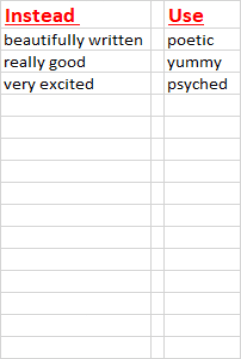
Or if you are very tired (weary) of using crutch words you might want to click on  OneLook Reverse Dictionary. Just type in the phrase and up pops suggestions. Give it a try and begin your own vocabulary cheat sheet. Excel and Microsoft Word are perfect for making your own list.

Click and read…

Patricia’s Weekend Pick––Very, very, very  BY 

Do you use cheat sheets?

Have one you’d like to share? Do tell.

Do you edit out most adverbs?

I HOPE YOU’LL TAKE A MINUTE TO FOLLOW ME ON SOCIAL MEDIA, JUST CLICK ON THE BUTTONS BELOW. I’LL LEAVE A LIGHT ON.


Do you know the right way to kill a character?

Are you writing a mystery, who-done-it, legal thriller, or suspense story?

Then remember the devil is in the details.

In death, like pregnancy, there are no half-measures. After reading an article by Matt Knight, killing off one of my characters is more complicated than I realized. 


What did I learn from Matt?

  • There is a big difference between Murder, Manslaughter, and Homicide. And I need to understand the difference!

Feel free to save the above quick reference. 

His article goes into much more detail. I recommend you click and read. You never know when one of your characters might go off the rails and kill someone.

Murder, Manslaughter, or Homicide – What is the difference? By Matt Knight 

Is any of this new to you?

Are you planning on killing off a character?

Tell me what you think!

I HOPE YOU’LL TAKE A MINUTE TO FOLLOW ME ON SOCIAL MEDIA, JUST CLICK ON THE BUTTONS BELOW. I’LL LEAVE A LIGHT ON.