How to unlock the Writer hiding in a Storyteller

Do you need to convert a story to the written word?

Tried and failed? Why didn’t your story didn’t convert?

I bet at some time in your life, you’ve enjoyed telling a good yarn. Whether it’s around a campfire, the bed of a toddler, or long-winded joke with coworkers. The ability to tell a good story doesn’t always make a good writer.

When my children were very small, I would make up stories to distract them. I’d let them contribute by adding characters. When a long walk became boring or tiring for there little legs, the walk became a safari searching for animals behind trees and tall weeds. Long car drives became guessing games that could evolve into a story.  They never wondered why a giraffe was eating a neighbor’s yard eating leaves. They never questioned that lions weren’t native to the USA. 

Those were special moments when they listened in rapt awe to everything I said, too bad those years were short.

Why does a story not automatically translate with ease on to the written page?

It was this big!

I’m an animated talker. I can’t talk without my hands much less tell a good story without hand gestures, facial gyrations or even moving about. My voice rising with the action and softens with the tension. This makes it easy to convey to the listener what happened in the story.

However, all of that movement isn’t easy to put into words without exhausting the reader and losing their interest.

After reading a great article 6 Key Differences Between Storytelling and Writing by Gordon Long a few things about writing clicked into place for me.

What clicked?

  • Storytellers are performers.
    • We pace, wave, laugh and do all kind of gestures when telling a story.
  • It’s called telling a story for a reason.
    • Telling rather than showing doesn’t translate well. Readers what to see the action.
  • A storyteller peppers the story with adverbs. And we writers know all about adverbs.
  • A storyteller head hops and it works because he can act out each character. Head hopping is harder for a writer.
  • A writer must be more direct with dialog.
  • Unlike a writer, the storyteller is stuck with chronological order.

Most of all, Gordon Long points out that a storyteller is allowed to tell, a writer must show.

Be sure and click on his link and read his in-depth post to improve your writing.

6 Key Differences Between Storytelling and Writing by Gordon Long

Okay, tell me what you think.

Are you a better storyteller than a writer?

Does any of Mr. Long’s tips resonate with you?

PLEASE TAKE ANOTHER MINUTE AND LOOK ME UP ON SOCIAL MEDIA BY CLICKING ON THE LINKS BELOW.
AND STOP BY JEAN’S WRITING ANYTIME, I’LL LEAVE A LIGHT ON. 

FacebookTwitterAmazonPinterestStumbleupon 


How to rewrite with more impact

Switch out those inactive words with power words.

Hit your reader straight on and leave them in awe.

K.M. Allan tells us to check this list against our writing and replace with active words. And you all know, I do love lists.

The Active Word Checklist by K.M. Allan

I am guilty of peppering my writing with many of these words. Especially “could, had, thought and maybe.” Maybe is my big crutch word. 

Thank goodness for the find and replace feature. Using find & replace with this list as a starting point will tighten my writing a lot.

Tell me what you think.

Which words do you overuse?

Will removing words on this list help you?

PLEASE TAKE ANOTHER MINUTE AND LOOK ME UP ON SOCIAL MEDIA BY CLICKING ON THE LINKS BELOW.
AND STOP BY JEAN’S WRITING ANYTIME, I’LL LEAVE A LIGHT ON. 

FacebookTwitterAmazonPinterestStumbleupon 


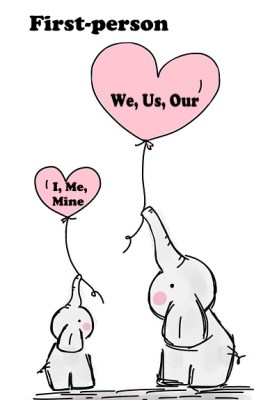
How to make writing in first-person easier

Do you struggle with first-person narratives?

I do. Even though it’s my favorite point of view.

I love writing, and reading, first-person point of view stories. But getting it right can be a struggle. I was thrilled to read a recent post on writing techniques from Bookfox

Writing in First Person: 4 Tricks and 6 Pitfalls

The article breaks down the simple do’s and don’ts that make writing in first-person simpler and easier. And reminded me, there are some wonderful, famous authors who wrote in first-person. In addition to thousands of classic works of literature. Selecting first-person POV need not be a hindrance to good writing.

How these writing techniques clicked for me.

  • To find a character’s voice, give them attitude.
  • Do not let the narrator be dull. Don’t want to put your reader to sleep.
  • Showcase your character’s blind spot. We all have them and so should a fictional character.
  • Decide as an author how much your reader can trust your character. Pathological liar or only tells little white lies.
  • Direct the attention on to another character. The narrator has the power to showcase other characters.
  • Make the narrator’s faults interesting.
  • Don’t trap the reader with a one-sided conversation.
  • Give good strong supporting characters for your narrator.
  • Remember writing in first-person is like acting. Leave your personality at home and embrace the fictional character.
  • Avoid filter words. We all know about those.
  • Create sentences that imply the word “I.” It’s easy to overuse the I.
  • Don’t get carried away with monologues and introspection. A little goes a long way.
  • Make obstacles for the narrator, this will encourage you to be more creative.

In addition to several good tips and tricks, the article also explains the different types and techniques for writing in first-person. There is also a cool instructional video.

Okay, now I want to know…

Which POV do you prefer?

Why do you prefer to write in this POV?

Do you enjoy reading books in all POV? 


Do click and read more in-depth.

Writing in First Person: 4 Tricks and 6 Pitfalls


PLEASE TAKE ANOTHER MINUTE AND LOOK ME UP ON SOCIAL MEDIA BY CLICKING ON THE LINKS BELOW.
AND STOP BY JEAN’S WRITING ANYTIME, I’LL LEAVE A LIGHT ON. 

FacebookTwitterAmazonPinterestStumbleupon 


How to choose the best name for your character

A name is very important to your reader. Names, first and last, define a character enabling the reader to envision the character. 

Do you struggle with selecting a cool name?

I do! Every time I sit down to develop a new character, I struggle.

This isn’t the first time I’ve written about selecting the best name.  I’ve tried name generators and had mixed results. On rare occasions, a name comes to me and just fits. You know what I mean?

Other times as with the antagonist in my current WIP, selecting a name is a major pain in my ass. I’ve changed her name a dozen times or so it seems. Her name still doesn’t work for me. At times I’ve called her Madame X just so I could get a scene down. Come to think of it Madame X, hmm. No, definitely not.

I recently received a newsletter with a video about this very subject. And as usual, I learned something new.  This video is so good, I watched it three times. So I decided to share.

Here are the tips I gleaned from Chris Fox.

Start with an adjective that describes the character.

  • Short or tall?
  • Fat or slim?
  • Little/small?
  • Rugged or polished?
  • Young/old?

Next, add color.

  • Black, or white?
  • Pale or tanned?
  • Red
  • Dark /light

Combine these attributes with a noun that describes temperament or appearance. Such as…

  • Beard
  • Hair
  • Eyes
  • Mad
  • Hateful
  • Funny
  • Humble

Or combine with social status.

  • Baker
  • Politician
  • Doctor
  • Lawyer
  • Knight
  • Farmer
  • Blacksmith
  • Social climber

Or combine with the region they’re from. A city, wealthy, and well-educated or a person from Europe, may have a longer first name. If they are from a small town their name is more often as not a shortened version or nickname.

  • City (highrise, small apartment)
  • Small town (suburban house)
  • Farm
  • Northern city/town
  • Southern city/town
  • Swamp
  • Mountains/beach
  • France
  • Africa
  • Italy
  • Ireland

A name comes from 4 primary categories.

  1. Patronymic: a name derived from that of the father or a paternal ancestor usually by the addition of an affix
  2. Locative: If a person from a certain region, or country, you may want to anglicize a name or translate to a different language. Google translate is great for this.
  3. Socioeconomic/Job title/status: of, relating to or involving a combination of social and economic factors
  4. Nicknames:  a substitute for the proper name of a familiar person, place, or thing, for affection or ridicule
    1. Looks, behavior often attributed to this name.

My tip: What finally helped me select the perfect name for my antagonist?

Google! After using these suggestions I came up with two or three I liked. Then I Googled the meanings of each. Voila! Found what I needed.

At last, I settled on Margo Richardson for my troublemaker.

Question: 

How do you select your characters name?

Want another great website to find a cool name?

Try13 Ideas for Creating Cool Character Names

For your watching pleasure…

PLEASE TAKE ANOTHER MINUTE AND LOOK ME UP ON SOCIAL MEDIA BY CLICKING ON THE LINKS BELOW.
AND STOP BY JEAN’S WRITING ANYTIME, I’LL LEAVE A LIGHT ON. 

FacebookTwitterAmazonPinterestStumbleupon