Posts

Do you know what makes great dialogue?

Turns out great dialogue contain beats. 
Sunday’s are when I catch up on my reading. Blog posts I’ve missed or tagged to read are saved for a slow Sunday afternoon. There are so many great bloggers/writers it’s hard to keep up, but I do try.

I’ve been working on dialogue in my WIP, so you can imagine my excitement when I came across not one but two posts by Dan Alatorre on how to make that dialogue great.

Like Dan, I like to bang out the dialogue fast and get the gist down before I lose the flow. Works more times than not.

What I learned from Dan today…

  • Write like people talk. In my family, the women drive the men crazy talking over each other, no such thing as one-at-a-time.
  • Don’t forget the beats. Yes, a dialogue needs beats.
  • A trick to adding those beats, jot down a list of actions to match conversation. Sort of like setting out all the ingredients before baking a delicious cake.

Click on the links below and read all of Dan’s tips and tricks to turn your good dialogue into great dialogue.

3 Steps To Brilliant Dialogues In Your Stories By

Dan Alatorre

How Your Dialogues Mess Up Your Story, Part 2 By Dan Alatorre
 

Now tell me, did you learn something new?

Do you have a dialogue tip to help me?

Do you find writing dialogue hard?

I HOPE YOU’LL TAKE A MINUTE TO FOLLOW ME ON SOCIAL MEDIA, JUST CLICK ON THE BUTTONS BELOW. I’LL LEAVE A LIGHT ON.


Do you want a good writing cheat sheet?

I love finding great writing tips!

Thanks, today goes to Patricia Lynne for ways to substitute the word very.

I don’t know about you but sometimes I get into a very rut. I try not to worry about using words like very when in draft mode. But when it comes time to edit, that word needs to get scarce.

And that’s where Patricia’s cheat sheet comes in handy.

If you’re searching for an expression to explain how very excited (psyched) a character is, check out her post and learn how to avoid very. 
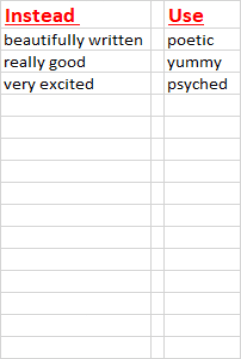
Or if you are very tired (weary) of using crutch words you might want to click on  OneLook Reverse Dictionary. Just type in the phrase and up pops suggestions. Give it a try and begin your own vocabulary cheat sheet. Excel and Microsoft Word are perfect for making your own list.

Click and read…

Patricia’s Weekend Pick––Very, very, very  BY 

Do you use cheat sheets?

Have one you’d like to share? Do tell.

Do you edit out most adverbs?

I HOPE YOU’LL TAKE A MINUTE TO FOLLOW ME ON SOCIAL MEDIA, JUST CLICK ON THE BUTTONS BELOW. I’LL LEAVE A LIGHT ON.


Do you know the right way to kill a character?

Are you writing a mystery, who-done-it, legal thriller, or suspense story?

Then remember the devil is in the details.

In death, like pregnancy, there are no half-measures. After reading an article by Matt Knight, killing off one of my characters is more complicated than I realized. 


What did I learn from Matt?

  • There is a big difference between Murder, Manslaughter, and Homicide. And I need to understand the difference!

Feel free to save the above quick reference. 

His article goes into much more detail. I recommend you click and read. You never know when one of your characters might go off the rails and kill someone.

Murder, Manslaughter, or Homicide – What is the difference? By Matt Knight 

Is any of this new to you?

Are you planning on killing off a character?

Tell me what you think!

I HOPE YOU’LL TAKE A MINUTE TO FOLLOW ME ON SOCIAL MEDIA, JUST CLICK ON THE BUTTONS BELOW. I’LL LEAVE A LIGHT ON.


Do you want to know how long to make a story?

Size matters.

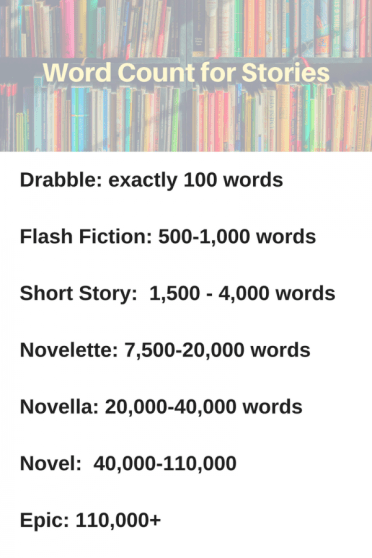
Some say write until your done, but as with all things, there is a rule of thumb. And knowing where the goal-line is may be helpful.

Want to know the answer?

I do agree we should write until finished, however, goals and guidelines are helpful. And as usual, successful writers/bloggers come to the rescue. With the help of friends, you can take the guesswork out of the numbers. 


Flash Fiction?

Generally, unless restricted by rules of a publication or contest, the word count for Flash Fiction is under 1,000. If submitting to a specific publication be sure and check their requirements.

A Drabble?

A Drabble is exactly 100 words, not including the title. Writing 100 words is not as easy as you might think. Takes practice. Give it a try.

Short story?

A short story length generally falls somewhere between 1,500 and 4,000 words. As with flash fiction, if submitting to a specific publication, check their rules.

Novelette, Novela?

In our fast-paced world, the Novelette and Novela are becoming very popular.  A Novelette is usually between 7,000 and 20,000. The Novela word count is between 20,000 -40,000.

Novel or Epic?

Novels vary between 40,000 – 110,000 depending on genre. Writing an epic is a big challenge. These tombs are over 110,000. Whew!

Here are my own cheat sheets.

Feel free to copy and paste them into your computer.

Robin Woods breaks down the word count further into genres. Be sure and read her post…

WORD COUNT 101: NOVEL? NOVELLA? NOVELETTE?


Christine Frazier breaks down the books into chapters and chapter count. This information can be really helpful in keeping your book consistent. Know where and how to break a chapter is important. Unless there is a compelling reason, you wouldn’t want your book to give the reader whiplash with one chapter 1000 words and the next one 4,500. Christine breaks down a few popular novels for us.

Playing the Numbers: Basic Word Counts by 


As with all rules, some are made to be broken. But, I find having guidelines and goals make me a better writer. What about you?

Want to read more about correct word counts keep reading. Here are more great posts on the subject.

Novel and Short Story Word Counts | WritersDigest.com 

What is the Perfect Length of Short Stories? 

How to Write a Drabble

Was this information helpful?

Do you think guidelines are useful?

Leave me a comment and tell me what you think.

I HOPE YOU’LL TAKE A MINUTE TO FOLLOW ME ON SOCIAL MEDIA, JUST CLICK ON THE BUTTONS BELOW. I’LL LEAVE A LIGHT ON.