Do you want to write dialog like a pro?

Of course, we all do.

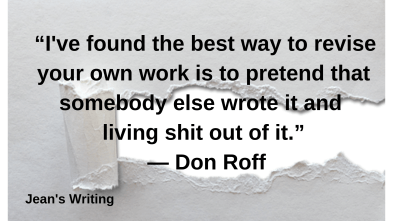
Quote on editing by Don Roff

I’ve been a big fan of and save many of her articles. Here is one of my favorites.

Perspective: Self-Editing Your Dialogue and Characters

She explains how to avoid stilted dialog and shows us how to add dimension to enable the reader to relate to your characters.

Do you need to tweak character dialog?

If so, read Kristen tips to make your character come alive.

Read her article, then go back and read some of your WIP.

Do you see any stilted conversations? 

Do you have a tip for adding life to characters?

PLEASE TAKE ANOTHER MINUTE AND LOOK ME UP ON SOCIAL MEDIA BY CLICKING ON THE LINKS BELOW.

AND STOP BY JEAN’S WRITING ANYTIME, I’LL LEAVE A LIGHT ON. 

FacebookTwitterAmazonPinterest


How to avoid turning off your readers

Okay, confession time. I haven’t been writing for the past few weeks. Nothing but cold, wet weather and to top this misery up pops Daylight Savings Time. Yuck. Green sickly emoticon

But, today is sunny so, I’m back at my desk attempting to make some forward progress on my blog in addition to the 2 WIP sitting here.

You may ask what I’ve done all my time…
Ahem, Jean Cogdell BitmojiReading, reading and reading. Devouring books of all types. The good, great, bad and ugly. Some I’ve not been able to finish. Life is too short to spend hours reading junk. So, I may toss a couple of duds in search of a really good read. Found a few.

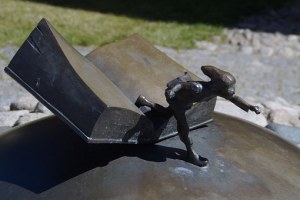
All this reading got me to thinking. Why do I reject a book after just a couple of chapters? Or even a few pages? And most of all, what can I do to avoid readers rejecting my stories? No writer wants them to run screaming from our books. Not unless we scare the pants off of them. LOL Nils Holgersson statute
Look what I found…

TOP 8 PROBLEMS THAT TURN READERS OFF BY CARLY HAYWARD

Ms. Hayward gave me a lot suggestions. Some I related to and some I need to chew on but all I want to avoid in my writing. Whether you write, children’s books, novels, flash or short stories these tips will help you tighten up your writing.

My takeaway…

  1. Head Hopping
    • While this may not bother some readers, it drives me nuts. I already striver to avoid this one.
  2. Missing Main Character
    • This happens when a writer fails to introduce the MC within the first few pages.
  3. Too Much Backstory
    • Okay, here is another of my reading pet peeves. Try not to put the reader to sleep with history.
  4. Floating Head Dialog
    • Ground the reader before throwing them in the middle of a conversation. If you must start in the middle of a conversation, make sure the reader understands who is talking.
  5. Action without Grounding.
    • We’ve all heard, start with action. But you still need to ground the reader or they won’t care what’s happening.
  6. The Recap
    • Easy going over past events. Instead of a character going over what led them to a place, show the reader what happened to avoid boring the reader.
  7. Distant Beginnings
    • In an effort to convey a sense of mystery a writer may leave too many details vague. Don’t. You need to let the reader connect to the character.
  8. Overdone Beginnings
    • Don’t start with a cliché. There are no new beginnings, but add something to yours and make it special. Hook the reader with something unique.

Be sure and click on Ms. Hayward’s article (here) and read everything she has to say about engaging your reader.

Which one of these 8 puts you off a book?

Do you have any suggestions to add to Ms. Hayward’s list?

PLEASE TAKE ANOTHER MINUTE AND LOOK ME UP ON SOCIAL MEDIA BY CLICKING ON THE LINKS BELOW.

AND STOP BY JEAN’S WRITING ANYTIME, I’LL LEAVE A LIGHT ON. 

FacebookTwitterAmazonPinterest


Can you really recognize a liar?

We all like to think we can spot a lie from ten paces. But can we really? How many times has someone fooled you?

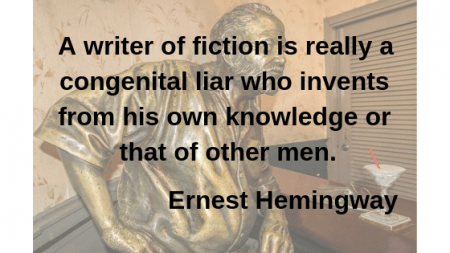
Ernest Hemingway quote - A writer of Fiction...

Why am I asking about liars? Because knowing how to spot one, is helpful in writing. If we know how people recognize when someone is lying we can use those signs for a villain. The body language of a liar is great fodder for a story.

Add body language of a liar to round out your antagonist.

 So if you bullshit meter needs fine turning then check out this article on this subject…

10 Easy Ways to Recognize Liars by 

Here is the show don’t tell, tips I gleaned about liars.

  • Fails to make eye contact. Looks at the floor, ceiling or hands. Or, make eye contact with an unblinking stare.
  • Avoids using contractions.  “I did not…” instead of “I didn’t…”
  • Answers question with a question to stall for time.
  •  They fidget sometimes excessively with ear, nose, or pockets, purses or play with keys etc.
  • Turn away from the speaker, blink rapidly, smile falters. Cross their arms which is a sign of being “closed” to the subject.
  • Runaway talker. They might embellish their story to make it more believable.
  • Gets angry. Becomes defensive. Tries to divert attention on to another person.
  • Changes the subject to avoid answering a question.
  • Eyes are the big tip-off. Right-handed people will look up and to the left if trying to remember. If trying to make something up, they look to the right.
  • They may blink rapidly or rub eyes.
  • Sweating,  blushing, trembling and difficulty swallowing may indicate a lie.
  • Don’t miss the micro-expressions. A fleeting smile, a furrowed brow, etc. Although quick, these can tell you a lot.

Knowing the signs of a liar is great fodder for a writer.

What do you think? See anything to help with your writing?

Do you have any tips about the body language of a liar? Or truth teller?

How do you describe a lying snake of a villain?


PLEASE TAKE ANOTHER MINUTE AND LOOK ME UP ON SOCIAL MEDIA BY CLICKING ON THE LINKS BELOW.

AND STOP BY JEAN’S WRITING ANYTIME, I’LL LEAVE A LIGHT ON. 

FacebookTwitterAmazonPinterestStumbleupon 


What do you think about first point of view?

Which do you prefer second, third or multiple?Writers what is best POV?When I first began, writing in first person POV was frowned upon. Many bloggers insisted it was a hallmark of a novice. This was frustrating as hell because I love writing in 1st POV.

Now I understand that’s not what determines you, as a writer. Each writer is unique as is their story. A good story stands out no matter the POV.

There are pros and cons to everything, even the chosen POV. However, good stories are good and the only thing (IMHO) that waves the red flag of a novice is bad editing.

Thanks to one of my favorite bloggers for sharing…

10 Advantages of Writing a Single-POV Story (What I Learned Writing Wayfarer)  by 

Why I like first person POV…

  • Understanding who is narrating the story is simple. No flipping back and forth to refresh my memory on the who.
  • The narrator’s journey gives a closer connection to the POV and story.
  • Focus of the story, plot, and the theme are more direct.
  • Subplots and supporting characters are directly connected to the narrator.
  • Single POV calls for tighter writing. (I love writing flash.)

Bottom line there is no right or wrong POV. We all must be true to the story.

Tell me…

Which POV do you prefer? Why?

Have you tried your hand at the other POV’s?

PLEASE TAKE ANOTHER MINUTE AND LOOK ME UP ON SOCIAL MEDIA BY CLICKING ON THE LINKS BELOW.

AND STOP BY JEAN’S WRITING ANYTIME, I’LL LEAVE A LIGHT ON. 

FacebookTwitterAmazonPinterestStumbleupon